How to Prevent Plumbing Problems When Installing a New Outdoor Drip Irrigation Filter
A drip irrigation system can help homeowners water gardens, flower beds, shrubs, and landscaped areas efficiently. By delivering water directly to the soil near plant roots, drip irrigation can reduce unnecessary overspray and provide more controlled watering than some traditional sprinkler arrangements.
For homeowners in Billings and Laurel, Montana, drip irrigation can be especially useful during the warmer growing season. However, maintaining consistent water flow requires more than installing tubing and emitters. One important component is the drip irrigation filter.
An outdoor drip irrigation filter helps remove sediment and debris from the water supply before they reach small irrigation emitters. Without proper filtration, these components can become clogged, resulting in uneven watering, reduced water flow, and unnecessary maintenance.
Although installing a filter may appear straightforward, improper placement, incompatible fittings, excessive pressure, and neglected maintenance can create plumbing problems.
Understanding how drip irrigation filters work and how to install them correctly can help homeowners maintain reliable outdoor watering systems.
Brown Plumbing & Heating can help homeowners in Billings and Laurel evaluate outdoor water supply concerns and determine appropriate plumbing solutions for irrigation connections.
Why Drip Irrigation Systems Need Filtration
Drip irrigation systems use small openings to deliver controlled amounts of water to plants.
These openings are much smaller than those found in many conventional garden hoses or sprinklers.
As a result, sediment, mineral particles, and other debris can interfere with water flow.
Even relatively small particles may clog emitters or restrict water movement through irrigation tubing.
A drip irrigation filter helps capture particles before they reach these sensitive components.
Depending on the water source, the filter may collect sand, rust particles, sediment, or other suspended material.
However, a standard sediment filter does not remove every type of water contaminant.
Dissolved minerals, for example, may pass through the filter and still contribute to deposits in irrigation equipment.
Choosing an appropriate filtration system and maintaining it regularly can help reduce emitter blockages and improve irrigation performance.
Understand the Different Types of Drip Irrigation Filters
Several types of filters are commonly used in drip irrigation systems.
Screen filters use a mesh screen to capture particles larger than the openings in the screen.
These filters are often used when the water supply contains relatively small amounts of suspended debris.
Disc filters use a stack of grooved discs that create narrow pathways to trap particles.
They may be useful in systems where the water contains different types of suspended material.
Other irrigation systems may use media filtration or additional treatment equipment, particularly when water quality presents more demanding filtration requirements.
The appropriate filter depends on the water source, irrigation equipment, and expected sediment load.
Homeowners should not assume that the most expensive or finest filter is automatically the best choice.
A filter that is too restrictive or poorly matched to the system may require frequent cleaning and contribute to pressure loss.
Reviewing the irrigation equipment manufacturer’s recommendations can help identify the correct filtration method.
Choose the Correct Filter Rating
Drip irrigation filters are often rated according to mesh size or filtration level.
This rating describes the size of particles the filter is intended to capture.
Different irrigation emitters may require different filtration levels.
A filter that allows particles larger than the emitter’s recommended limit to pass through may not provide adequate protection.
However, choosing unnecessarily fine filtration can create other problems.
A very fine filter may clog more quickly, especially when the water contains significant sediment.
As debris accumulates, the pressure difference across the filter can increase and reduce available flow.
Homeowners should select a filter that meets the specifications of the connected irrigation equipment.
The correct filtration rating should be based on the manufacturer’s requirements rather than guesswork.
Proper sizing helps balance emitter protection with reliable water flow.
Evaluate the Water Source Before Installation
The quality of the water entering the irrigation system affects filter selection and maintenance requirements.
A system supplied by municipal water may have different filtration needs than one supplied by a private well or another approved water source.
Well water may contain suspended sand or sediment that requires additional consideration.
Some irrigation systems may also receive water from approved nonpotable sources.
These applications can require specialized filtration and additional safeguards.
Homeowners should understand the source of their irrigation water before purchasing a filter.
If sediment is frequently visible in outdoor faucets or irrigation equipment, the water supply may require further evaluation.
A filter can help protect downstream irrigation components, but it should not be used to conceal an unresolved plumbing problem.
For example, recurring rust particles or unusual sediment may indicate conditions elsewhere in the water system.
Identifying the source of debris can help homeowners choose an appropriate solution.
Install the Filter in the Correct Location
Filter placement is important for effective irrigation performance.
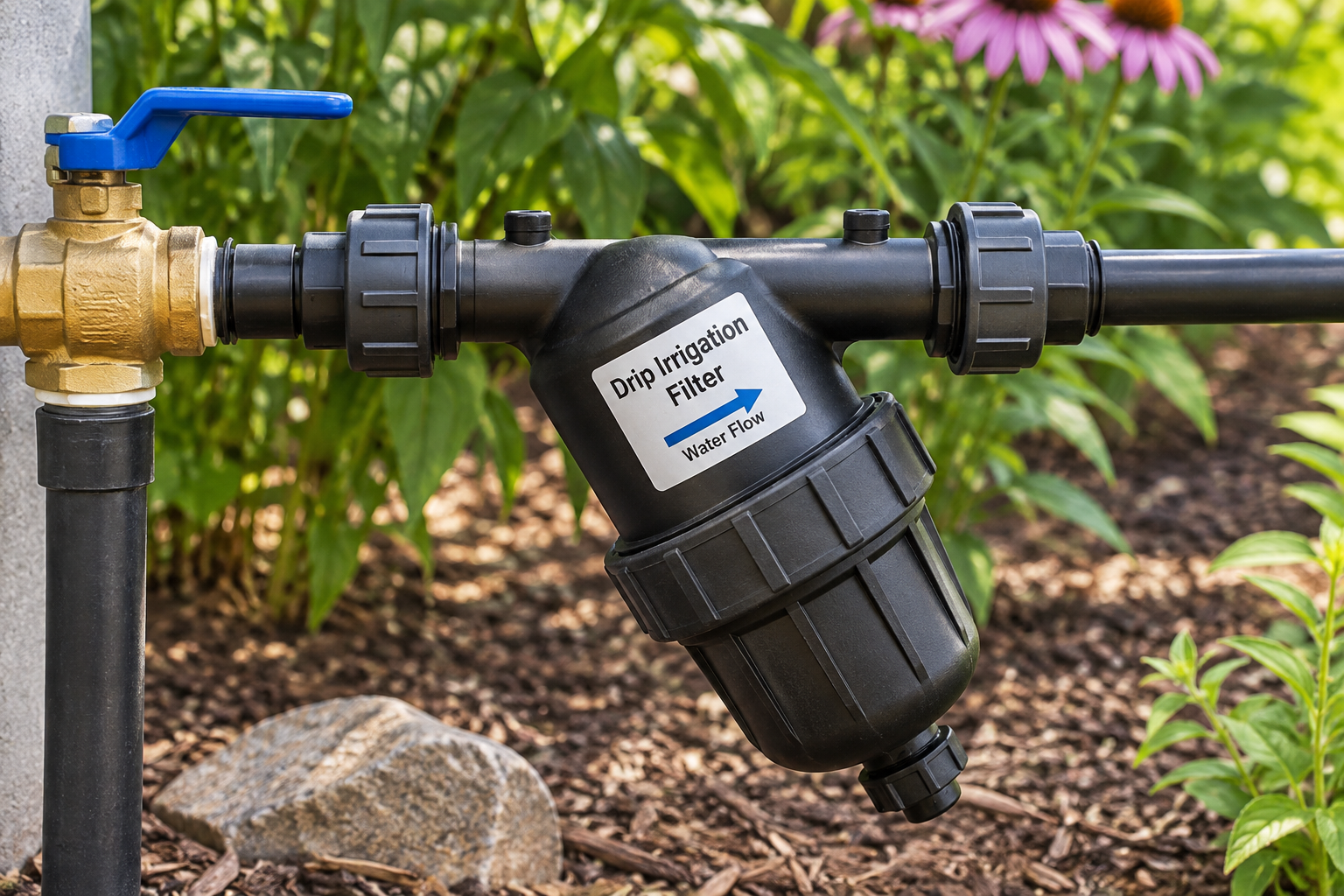
In many drip irrigation systems, the filter is installed upstream of the drip tubing and emitters so debris can be removed before reaching those components.
The correct arrangement of the filter, pressure regulator, valves, and backflow prevention equipment depends on the system design and manufacturer instructions.
Homeowners should not assume that every irrigation system uses the same component order.
Some filters are designed to operate within specific pressure ranges or installation orientations.
Installing a filter backward may interfere with its operation.
Most filters include directional markings that indicate the intended flow path.
These markings should be checked before installation.
The filter should also be positioned where it can be accessed for cleaning and inspection.
A properly located filter protects irrigation equipment without creating unnecessary maintenance difficulties.
Use Compatible Plumbing Fittings
Drip irrigation filters may connect to threaded fittings, irrigation tubing adapters, or other approved components.
The correct fittings depend on the filter design and the water supply piping.
Using incompatible fittings can create leaks or damage the filter housing.
Before installation, verify the connection size and thread type.
Some irrigation components use plastic threads that can crack if overtightened.
Homeowners should follow the manufacturer’s instructions for sealing threaded connections.
Not every connection requires the same sealing material.
Avoid forcing fittings together when the threads do not align properly.
Cross-threading can permanently damage the filter housing and lead to leaks.
If adapters are necessary, choose components rated for the intended pressure and application.
Correct fittings help maintain a secure connection and reduce the likelihood of water loss.
Consider the Effect of Water Pressure
Water pressure affects both filter performance and the operation of drip irrigation equipment.
Many drip irrigation systems require lower operating pressures than those commonly available from household water supplies.
A pressure regulator may be necessary to protect tubing and emitters.
The filter must also be rated for the pressure it will experience at its installed location.
A filter placed upstream of a pressure regulator may be exposed to higher supply pressure than components installed downstream.
Homeowners should verify the pressure ratings of every component.
Filters also create some resistance to water flow.
As debris accumulates, this resistance may increase.
An undersized or clogged filter can contribute to reduced pressure at the emitters.
Proper filter selection and pressure regulation help maintain consistent irrigation performance.
Avoid increasing household water pressure to compensate for a restricted filter.
Cleaning or replacing the filter may be the more appropriate solution.
Match the Filter to the Irrigation Flow Rate
Every irrigation filter has a recommended operating flow range.
A filter that is too small for the system may create excessive pressure loss.
A filter that is significantly oversized may be unnecessary and may not perform as intended under certain operating conditions.
Before selecting a filter, determine the expected flow rate of the irrigation zone.
The total demand depends on the number and type of emitters connected to the system.
For example, a small raised garden bed may require considerably less water than a large landscape irrigation zone.
If several zones operate independently, filter placement and sizing should account for the maximum expected flow through the filter.
Homeowners should review the manufacturer’s flow specifications.
Proper sizing helps maintain reliable water delivery while reducing unnecessary restrictions.
Protect the Household Water Supply From Backflow
Backflow prevention is an essential consideration when connecting irrigation equipment to a potable water supply.
Drip irrigation tubing is often located near soil, fertilizers, and other potential contaminants.
Under certain conditions, water may move backward toward the household supply if appropriate protection is not installed.
A sediment filter does not function as a backflow prevention device.
Even a high-quality filter cannot replace the protection required for an irrigation connection.
The appropriate backflow prevention assembly depends on the system design, intended use, and applicable plumbing requirements.
Systems that introduce fertilizers or other chemicals may require additional safeguards.
Homeowners should verify that the complete irrigation installation includes approved backflow protection.
A qualified plumber can help determine the appropriate arrangement.
Protecting the drinking-water supply is just as important as protecting irrigation emitters from sediment.
Prevent Leaks Around the Filter Housing
A drip irrigation filter contains connections and seals that must remain watertight during operation.
Some filters use removable housings that allow the screen or disc assembly to be cleaned.
These housings may include O-rings or other sealing components.
If a seal becomes damaged, dirty, or improperly positioned, the housing may leak.
Before installation, inspect the filter for visible damage.
Make sure removable components are assembled according to the manufacturer’s instructions.
Avoid overtightening the housing.
Excessive force may damage plastic threads or sealing surfaces.
After installation, pressurize the system according to the manufacturer’s procedure and inspect for leaks.
Check the inlet, outlet, and removable housing connections.
If water escapes, shut off the supply and correct the problem before continuing operation.
Regular inspections can help prevent small leaks from becoming larger plumbing issues.
Make Filter Cleaning Easy
A drip irrigation filter requires periodic cleaning to remain effective.
The cleaning frequency depends on water quality, filter size, and irrigation usage.
A system supplied by relatively clean water may require less frequent maintenance than one exposed to significant sediment.
Homeowners should choose an installation location that allows the filter to be opened safely.
Avoid positioning the housing against walls, foundations, or permanent landscaping features that prevent removal.
Follow the manufacturer’s instructions before opening a pressurized filter.
Typically, the water supply must be shut off and pressure relieved before the housing is disassembled.
Remove the screen or disc assembly according to the product instructions.
Clean the components using the recommended method.
Avoid using tools or cleaning procedures that could damage the filtration surfaces.
Reassemble the housing carefully and inspect for leaks when the system is returned to service.
Accessible installation makes routine maintenance easier and more likely to be completed.
Recognize the Signs of a Clogged Filter
A clogged drip irrigation filter can affect the entire watering system.
One common warning sign is reduced water flow from multiple emitters.
Plants near the beginning of an irrigation line may receive more water than those farther away when pressure and flow become inadequate.
However, uneven watering can also result from damaged tubing, clogged emitters, or incorrect system design.
Homeowners should investigate the cause rather than assuming the filter is responsible for every performance problem.
Some filters include pressure measurement points that can help identify increasing resistance across the filtration element.
When available, these features should be used according to the manufacturer’s instructions.
If the filter repeatedly clogs shortly after cleaning, the water supply may contain more sediment than the equipment can reasonably handle.
Additional filtration or another system modification may be necessary.
Addressing recurring restrictions can help restore reliable irrigation performance.
Avoid Bypassing the Filter
When a filter becomes clogged, homeowners may be tempted to remove it temporarily so water can flow more freely.
However, operating a drip irrigation system without the required filtration can allow debris to enter the tubing and emitters.
Once particles become lodged inside small emitters, cleaning may be difficult.
Some components may require replacement.
Instead of bypassing the filter, identify why it is becoming restricted.
The filter may need cleaning, replacement, or a different filtration rating.
The water source may also require additional treatment.
If the filter is undersized, a properly rated replacement may improve performance.
Maintaining suitable filtration helps protect the entire irrigation system.
Prepare the Filter for Montana Winters
Freezing temperatures can damage irrigation filters when water remains trapped inside their housings.
In Billings and Laurel, winterization is an important part of outdoor plumbing maintenance.
A filter housing filled with water may crack if exposed to freezing temperatures.
Before winter, follow the irrigation system’s approved winterization procedure.
This may involve shutting off the water supply, relieving pressure, draining the filter, or removing certain components for storage.
The correct method depends on the filter and irrigation system design.
Some filters include drain plugs, while others require the housing to be opened.
Homeowners should not assume that draining the irrigation tubing automatically empties the filter.
If compressed air is used to winterize the irrigation system, follow the manufacturer’s instructions and appropriate safety procedures.
Improper compressed-air use can damage components or cause injuries.
Proper winter preparation helps prevent cracked housings and leaks when irrigation resumes in spring.
Inspect the Filter Before Spring Startup
Before returning the irrigation system to regular operation, inspect the filter and its connections.
Look for cracks, damaged threads, worn seals, and other signs of deterioration.
Check that the filtration element is clean and properly positioned.
If the filter was removed for winter storage, reinstall it according to the manufacturer’s instructions.
Open the water supply using the recommended startup procedure.
Inspect the housing and fittings for leaks.
Run the irrigation system and observe the flow from the connected emitters.
If performance is inconsistent, inspect the filter and other irrigation components before adjusting watering schedules.
Spring inspections can help identify damage before the system is used regularly.
Maintain the Filter Throughout the Growing Season
Routine maintenance helps keep a drip irrigation filter operating effectively.
Inspect the filter periodically for leaks and signs of restriction.
Clean the filtration element according to the manufacturer’s recommendations.
Check that the housing remains securely assembled.
If the system includes a pressure regulator, inspect it for signs of damage or malfunction.
Homeowners should also monitor irrigation performance.
Reduced flow, uneven watering, or recurring emitter blockages may indicate that the filtration system needs attention.
Keep the area around the filter accessible.
Avoid covering the housing with soil, mulch, or landscaping materials that prevent maintenance.
A simple inspection routine can help extend the service life of irrigation components and reduce water waste.
Know When Professional Plumbing Assistance Is Appropriate
Installing a drip irrigation filter may be straightforward when connecting compatible components to an existing, properly protected irrigation system.
However, some installations involve modifications to household water supply piping, pressure regulation, or backflow prevention.
Professional assistance may be appropriate when the irrigation system is connected directly to potable plumbing or when the existing supply does not provide suitable pressure and flow.
A plumber can also help evaluate recurring leaks, damaged connections, or unusual sediment problems.
If the filter repeatedly fails or the irrigation system experiences significant pressure loss, professional inspection may help identify the underlying cause.
Brown Plumbing & Heating can help homeowners in Billings and Laurel evaluate outdoor plumbing concerns and determine appropriate repair or installation options.
Keep Your Drip Irrigation System Working Reliably
An outdoor drip irrigation filter is a small component that plays an important role in protecting irrigation equipment.
By capturing sediment and debris before they reach small emitters, a properly selected filter can help maintain consistent watering and reduce unnecessary maintenance.
However, reliable performance depends on correct installation.
Homeowners should select a filter that matches the irrigation equipment, water quality, pressure, and flow requirements.
Compatible fittings, appropriate backflow protection, and accessible installation are also important.
For properties in Billings and Laurel, proper winterization helps protect filter housings from freezing damage.
Regular cleaning and inspection can prevent restrictions from affecting the entire irrigation system.
With careful installation and maintenance, a drip irrigation filter can support dependable watering while helping protect the home’s outdoor plumbing connections.
For homeowners experiencing outdoor water supply leaks, pressure problems, or damaged irrigation connections, Brown Plumbing & Heating can help assess the situation and recommend appropriate solutions.
Read Next: How to Prevent Plumbing Problems When Installing a New Outdoor Garden Irrigation Manifold