How to Prevent Plumbing Problems When Installing a New Outdoor Irrigation Flow Sensor
A reliable irrigation system helps homeowners maintain healthy lawns, gardens, and landscaped areas while managing water usage throughout the growing season. However, underground irrigation systems can develop leaks and other problems that are difficult to detect before significant amounts of water are wasted.
For homeowners in Billings and Laurel, Montana, installing an outdoor irrigation flow sensor can provide valuable information about how much water moves through their irrigation systems. When connected to compatible monitoring equipment, a flow sensor can help homeowners identify unusual water usage, detect certain leaks, and recognize irrigation performance problems.
Although flow sensors can improve water monitoring, proper installation is essential. Incorrect placement, incompatible fittings, poor electrical connections, and improper system configuration can lead to inaccurate readings or unreliable operation.
Understanding how irrigation flow sensors work and what installation requirements matter most can help homeowners protect their outdoor plumbing systems and make better decisions about water management.
Brown Plumbing & Heating can help homeowners in Billings and Laurel evaluate outdoor water supply concerns and determine appropriate plumbing solutions for irrigation installations.
Why Homeowners Install Outdoor Irrigation Flow Sensors
An irrigation flow sensor measures the amount of water moving through a particular section of an irrigation system.
Depending on the equipment, it may provide information about water flow during individual watering cycles or across the entire irrigation network.
This information can help homeowners understand whether their irrigation system is operating normally.
For example, a sprinkler zone that typically uses a consistent amount of water may begin showing unusually high flow if a pipe breaks or a sprinkler head becomes damaged.
A significant decrease in flow may indicate a restriction, partially closed valve, or another problem.
When the sensor connects to a compatible irrigation controller, the system may be able to compare actual flow with expected operating conditions.
Some controllers can generate alerts or stop watering when they detect abnormal water usage.
However, these features depend on the capabilities and configuration of the controller.
A flow sensor alone does not automatically stop leaks or shut off the water supply.
Understanding this distinction helps homeowners select equipment that meets their needs.
Understanding How an Irrigation Flow Sensor Works
Irrigation flow sensors measure water movement using different technologies.
Some models use mechanical components that move as water passes through the sensor.
Others rely on electronic measurement methods without the same type of moving mechanism.
Many residential irrigation systems use sensors that send electrical pulses to a compatible controller.
The controller interprets those signals to estimate the flow rate or volume of water passing through the line.
The measurement may be displayed in gallons per minute or another supported unit.
Flow sensors are generally installed in a water supply line serving one or more irrigation zones.
When an irrigation zone operates, water passes through the sensor and produces a measurable signal.
The controller can then use that information to monitor water usage.
However, each sensor has specific operating requirements.
Accuracy may depend on pipe size, water velocity, installation orientation, and the amount of straight piping available near the device.
Choosing the correct sensor and installing it according to the manufacturer’s instructions is essential for reliable measurements.
Choose the Correct Flow Sensor for Your Irrigation System
Not every irrigation flow sensor works with every controller or water supply arrangement.
Before purchasing equipment, homeowners should confirm that the sensor is compatible with their existing irrigation system.
Some manufacturers produce flow sensors designed specifically for particular controllers.
Other sensors may support multiple compatible monitoring systems.
The connection size must also match the irrigation piping.
A sensor intended for a larger irrigation supply line may not be appropriate for a small residential application.
Homeowners should review the manufacturer’s operating pressure, flow range, and installation requirements.
The sensor must be able to measure the expected water flow without creating excessive restriction.
A sensor that operates outside its rated flow range may produce inaccurate measurements.
Choosing suitable equipment can help avoid unnecessary replacement costs and unreliable monitoring.
Evaluate the Existing Irrigation Water Supply
Before installing a flow sensor, inspect the existing irrigation plumbing.
Identify the main supply line, master valve, backflow prevention assembly, and individual irrigation zone valves.
Understanding how these components are arranged helps determine where the sensor should be installed.
The water supply should also be evaluated for leaks or other existing problems.
If underground piping is already damaged, installing a flow sensor will not correct the issue.
Homeowners should address known plumbing problems before adding monitoring equipment.
The available pressure and flow should also be considered.
A flow sensor introduces another component into the irrigation supply line.
Although a properly sized sensor may have a relatively small effect on the system, some designs create measurable pressure loss.
If the irrigation system already has marginal pressure, this additional restriction may affect downstream equipment.
A qualified plumber can help determine whether the existing supply is suitable for a new flow sensor.
Select the Best Installation Location
Flow sensor placement is one of the most important factors affecting performance.
In many residential irrigation systems, a flow sensor is installed on the main irrigation supply line where it can measure water entering the downstream irrigation zones.
However, the correct location depends on the system design and the manufacturer’s instructions.
The sensor should generally be positioned so that it measures the water flow the controller is intended to monitor.
If the sensor is installed on a separate branch, it may not measure every irrigation zone.
Homeowners should also consider accessibility.
An underground installation may require a suitable valve box or other approved enclosure.
The sensor should remain accessible for inspection, maintenance, and replacement.
Avoid placing the sensor beneath permanent landscaping features, driveways, or other structures that could make future repairs difficult.
Careful placement helps support accurate monitoring and easier maintenance.
Allow the Required Straight Pipe Length
Many irrigation flow sensors require straight sections of piping before and after the device.
This is important because elbows, valves, tees, and other fittings can create turbulence in moving water.
Turbulent flow may affect measurement accuracy.
The amount of straight piping required depends on the sensor design.
Some manufacturers specify minimum upstream and downstream distances based on the pipe diameter.
Homeowners should follow those specifications rather than relying on a single generic recommendation.
Installing a sensor immediately next to an elbow or valve may produce inconsistent readings if the manufacturer requires additional clearance.
Before cutting into the irrigation supply line, verify that the proposed location provides enough room.
If the existing piping arrangement cannot accommodate the required clearances, the installation may need to be relocated or redesigned.
Proper spacing helps the sensor measure water flow more accurately.
Install the Flow Sensor in the Correct Direction
Many irrigation flow sensors are designed to measure water moving in a specific direction.
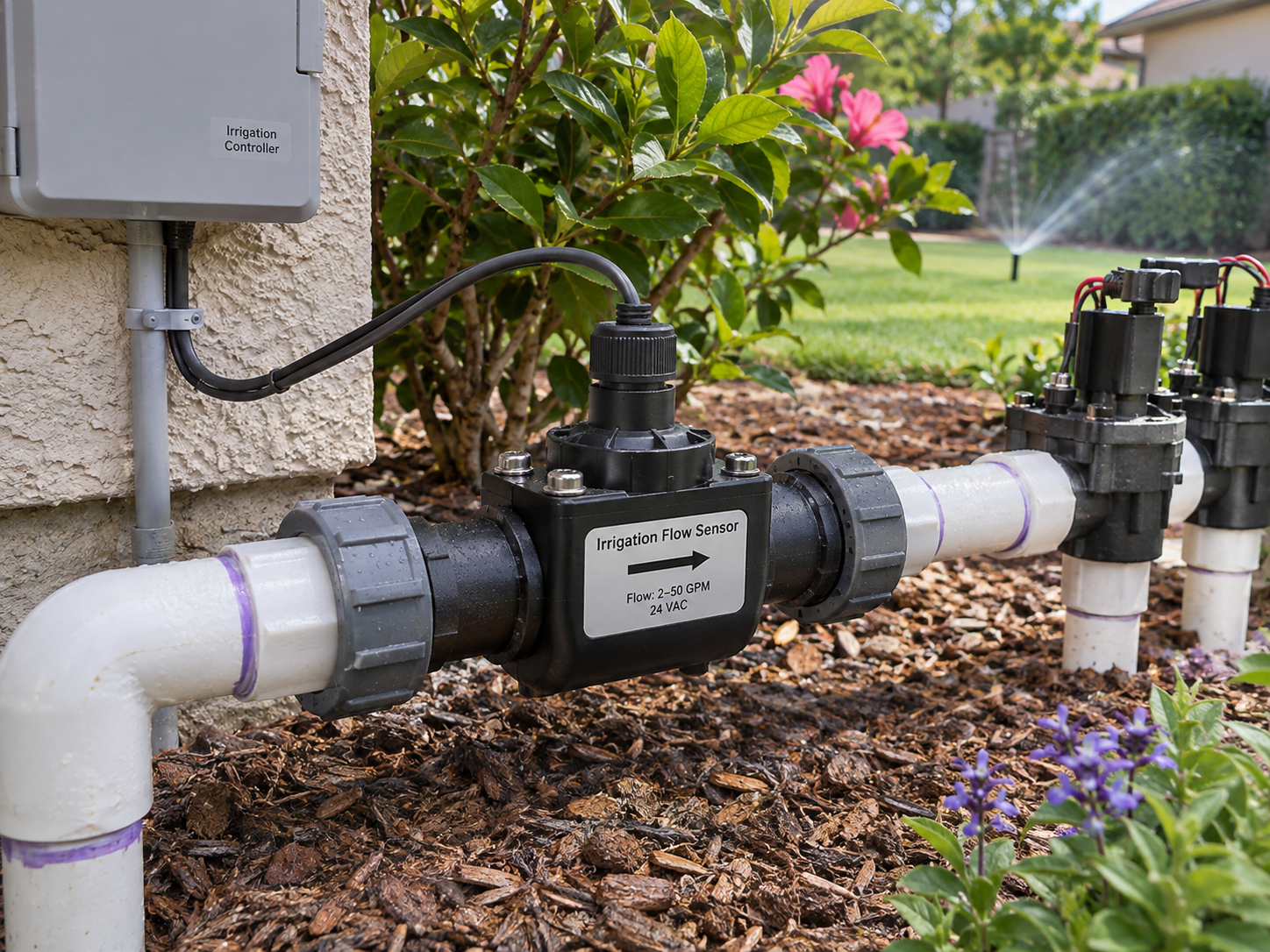
The sensor housing may include an arrow showing the required flow direction.
Installing the device backward can result in inaccurate readings or complete failure to register flow.
Before installation, identify the inlet and outlet.
Compare the arrow on the sensor with the actual direction of water movement through the irrigation supply line.
The installation orientation must also follow the manufacturer’s instructions.
Some sensors are designed for horizontal piping, while others permit specific vertical installations.
Certain designs require the pipe to remain full of water during operation.
Air pockets or partially filled piping can affect measurement accuracy.
Following the required flow direction and orientation helps prevent unnecessary monitoring problems.
Use Compatible Pipes and Fittings
A flow sensor must be securely connected to the irrigation supply piping.
Depending on the product, installation may involve threaded fittings, unions, solvent-welded connections, or another approved joining method.
Homeowners should confirm that the sensor and fittings are compatible with the existing piping materials.
Avoid forcing connections together or using adapters that are not rated for the application.
Plastic housings can become damaged if threaded fittings are overtightened.
The manufacturer’s instructions should determine the appropriate sealing method.
Some connections require sealing washers or O-rings rather than conventional thread sealant.
The connected piping should also be properly supported.
A flow sensor should not be forced between misaligned pipes or subjected to unnecessary bending stress.
Properly assembled connections help prevent leaks and protect the sensor from damage.
Locate Underground Utilities Before Excavation
Installing an irrigation flow sensor may require digging to expose the main irrigation line.
Before excavation, homeowners should identify underground utilities.
Residential properties may contain natural gas lines, electrical cables, communication lines, water supply piping, and other buried infrastructure.
Homeowners in Billings and Laurel should contact Montana 811 before digging to request utility marking.
However, privately installed lines may require separate locating services.
These may include irrigation pipes, landscape lighting cables, or other owner-installed connections.
Never assume that an area is safe to excavate simply because it is located in a lawn or garden.
Proper utility identification helps prevent accidental damage and serious safety hazards.
It also makes it easier to choose a suitable location for the sensor and any required enclosure.
Understand the Relationship Between Flow Sensors and Master Valves
An irrigation flow sensor and a master valve can serve complementary functions.
A flow sensor measures water movement.
A master valve controls the supply of water entering the irrigation network.
When both devices connect to a compatible controller, the system may be able to respond to certain abnormal flow conditions.
For example, a controller with supported flow monitoring features may detect unusually high water usage during an irrigation cycle.
Depending on its programming, the controller may close the master valve to limit further water loss.
However, this protection is not automatic unless the equipment supports the function and has been configured correctly.
Some irrigation controllers can monitor flow but cannot automatically shut off the water.
Others require specific sensor and valve models.
Homeowners should verify compatibility before purchasing additional equipment.
A flow sensor should not be described as a leak prevention device unless the complete system includes an appropriate response mechanism.
Keep Backflow Protection in Place
Backflow prevention is an important part of irrigation plumbing connected to a potable water supply.
Irrigation equipment may come into contact with soil, fertilizers, pesticides, and other potential contaminants.
Under certain conditions, contaminated water may move backward toward the household water supply if appropriate protection is not installed.
A flow sensor does not provide backflow protection.
It measures water movement but does not prevent reverse flow or isolate contaminants.
Homeowners should never remove or bypass an approved backflow prevention assembly to make room for a flow sensor.
The placement of monitoring equipment must be coordinated with the required backflow protection and other plumbing components.
Certain backflow prevention assemblies have specific clearance and accessibility requirements.
A qualified plumber can help determine whether the proposed installation is appropriate for the existing system.
Maintaining proper backflow protection helps safeguard household drinking water.
Protect the Electrical Connections From Moisture
Many irrigation flow sensors connect to a controller using electrical wiring.
Outdoor irrigation environments can expose wiring and connections to moisture, soil, and changing temperatures.
Improperly protected connections may corrode or become damaged.
When this happens, the controller may receive inconsistent information or fail to detect the sensor.
Homeowners should use electrical connectors and wiring methods approved for the intended installation environment.
Follow the manufacturer’s specifications regarding wire type, maximum cable length, and connection requirements.
Avoid leaving exposed conductors inside underground valve boxes.
If the sensor requires shielded cable or another specialized wiring arrangement, use the recommended materials.
Some systems may also have requirements regarding proximity to other electrical wiring.
Keeping connections properly protected can improve measurement reliability and reduce maintenance problems.
Configure the Irrigation Controller Correctly
Installing a flow sensor does not guarantee that an irrigation controller will immediately recognize it.
Many controllers require the sensor to be enabled or configured in their settings.
The controller may need information such as the sensor model, calibration factor, or other operating parameters.
These settings help the controller interpret the signals received from the sensor.
Incorrect configuration can produce inaccurate flow measurements.
Homeowners should follow the instructions for both the controller and the sensor.
Some systems also require individual irrigation zones to be calibrated.
During this process, the controller may measure how much water normally flows through each zone.
The resulting information can provide a baseline for future monitoring.
If the system supports alerts or automatic shutdown, those features must also be configured appropriately.
Correct programming is essential for reliable water usage monitoring.
Establish Normal Flow Rates for Each Irrigation Zone
Different irrigation zones can use significantly different amounts of water.
A lawn sprinkler zone may have a higher flow rate than a garden drip irrigation zone.
Because of these differences, flow monitoring is most useful when the system understands what normal operation looks like.
Some compatible controllers can learn or record the expected flow rate for each zone.
Others require the homeowner or installer to enter appropriate values.
Before relying on automatic alerts, verify that the baseline readings reflect normal system operation.
A damaged sprinkler head or leaking irrigation line can distort measurements during calibration.
For this reason, inspect the irrigation system before establishing expected flow values.
Homeowners should also recognize that changes to sprinkler heads, emitters, or zone layouts may affect normal flow.
If the system is modified, the monitoring configuration may need to be updated.
Accurate baseline readings help reduce unnecessary alerts and improve the usefulness of flow monitoring.
Understand What High Flow Readings May Indicate
An unusually high flow reading may indicate that more water is moving through the irrigation system than expected.
Possible causes include broken sprinkler heads, damaged underground piping, and malfunctioning irrigation valves.
A disconnected irrigation fitting may also allow water to escape rapidly.
However, high readings do not always indicate a plumbing leak.
Changes to the irrigation equipment or incorrect controller settings may affect expected water demand.
A sensor installed improperly may also produce inaccurate measurements.
When a high-flow alert occurs, homeowners should investigate the affected irrigation zone.
Inspect visible sprinkler heads and piping connections.
Look for unexpected pooling, excessive runoff, or unusually wet landscaping.
If an underground leak is suspected, shutting off the affected supply when appropriate can help limit water loss.
Professional evaluation may be necessary when the source of the problem is not visible.
Understand What Low Flow Readings May Indicate
A low flow reading can also provide useful information.
Reduced water movement may indicate a clogged filter, partially closed valve, damaged supply line, or another restriction.
Some irrigation zones may experience reduced flow when water pressure is insufficient.
However, a low reading does not automatically identify the cause.
If the irrigation system includes several zones, compare the affected zone with its normal operating conditions.
A problem affecting only one zone may involve its valve or distribution piping.
If all zones experience reduced flow, the issue may be located closer to the main water supply.
Homeowners should avoid increasing water pressure without first identifying the restriction.
Excessive pressure can damage irrigation components.
A systematic inspection can help determine whether the problem involves the sensor, plumbing, or connected irrigation equipment.
Recognize the Limitations of Flow Monitoring
Irrigation flow sensors can provide useful information, but they cannot detect every plumbing problem.
Very small leaks may fall below the sensor’s minimum measurement range.
Some controllers may also have alert thresholds that are too high to recognize minor changes in flow.
A leak located upstream of the sensor may not be measured.
If a damaged pipe loses water before it reaches the sensor, the monitoring system may not detect that loss.
Incorrect calibration can also affect the reliability of alerts.
Flow sensors should therefore be treated as monitoring tools rather than replacements for inspections and routine maintenance.
Homeowners should continue checking irrigation equipment for visible leaks, damaged fittings, and abnormal watering performance.
Understanding the system’s limitations helps set realistic expectations.
Test the Flow Sensor After Installation
Testing is essential before placing a newly installed flow sensor into regular service.
After completing the plumbing connections, restore water pressure according to the manufacturer’s instructions.
Inspect the sensor housing and nearby fittings for leaks.
Activate an irrigation zone using the controller.
Confirm that water flows through the system and that the controller registers an appropriate reading.
Repeat the process for other irrigation zones.
If the controller does not recognize the sensor, inspect the configuration and accessible wiring according to the manufacturer’s instructions.
A missing reading may result from wiring problems, incorrect programming, inadequate flow, or an installation issue.
Do not assume that the sensor is defective without checking the other components.
If abnormal-flow alerts are supported, test those features using the manufacturer’s recommended method.
Avoid intentionally creating uncontrolled leaks to test the system.
Proper testing helps confirm that the equipment is ready for regular use.
Watch for Signs of a Malfunctioning Flow Sensor
Flow sensors may develop problems due to wear, debris, damaged wiring, or other conditions.
One possible warning sign is a flow reading that remains at zero while irrigation equipment is operating normally.
Another concern is a reading that changes dramatically without a corresponding change in water usage.
However, these symptoms can result from several causes.
The problem may involve the sensor itself, electrical connections, controller configuration, or the actual irrigation supply.
Mechanical sensors may also become affected by sediment or other debris.
Homeowners should follow the manufacturer’s troubleshooting procedures.
Avoid opening or disassembling pressurized sensor components.
If the source of the problem remains unclear, professional inspection may be appropriate.
Correct diagnosis helps avoid unnecessary equipment replacement.
Maintain the Flow Sensor Throughout the Growing Season
Routine maintenance can help preserve accurate monitoring.
Inspect the sensor enclosure and accessible fittings periodically.
Look for leaks, damaged wiring, standing water, and physical deterioration.
If the sensor contains serviceable components, follow the manufacturer’s cleaning and maintenance instructions.
Some designs may require little routine maintenance, while others may be more sensitive to debris.
Homeowners should also review flow readings occasionally.
Changes in readings may provide an early indication of irrigation problems.
Keep the surrounding valve box or access area free of excessive soil and landscaping debris.
Avoid allowing roots or vegetation to obstruct the installation.
If the irrigation system is modified, verify that the monitoring settings still reflect the updated equipment.
Consistent maintenance helps keep the sensor useful throughout the watering season.
Prepare the Flow Sensor for Montana Winters
Winter temperatures in Billings and Laurel can damage irrigation equipment when water freezes inside exposed components.
A flow sensor may contain water within its housing and connected piping.
If this water freezes and expands, the sensor body or internal components may become damaged.
Before winter, follow the manufacturer’s recommended preparation procedures.
Some systems require draining, while certain sensor designs may need to be removed or otherwise protected.
The appropriate method depends on the product and installation.
Homeowners should not assume that shutting off the irrigation supply automatically empties the sensor.
Water may remain trapped in sections of piping or within the device.
If the irrigation system is winterized using compressed air, follow the equipment manufacturer’s instructions and appropriate safety precautions.
Some sensors may require special handling during the procedure.
Improper compressed-air use can damage equipment and create injury risks.
Careful winterization helps reduce the likelihood of costly spring repairs.
Inspect the Sensor Before Spring Startup
Before beginning the spring watering season, inspect the irrigation flow sensor.
Look for cracks, damaged fittings, loose electrical connections, and visible signs of freezing damage.
Check the surrounding enclosure for accumulated debris or standing water.
If the sensor was removed for winter storage, reinstall it according to the manufacturer’s instructions.
Restore water pressure using the appropriate startup procedure.
Inspect the sensor connections for leaks.
Activate each irrigation zone and confirm that the controller receives flow information.
If readings appear inaccurate, review the sensor settings and inspect the associated equipment.
Some controllers may require recalibration after maintenance or system changes.
Spring inspections can help identify problems before regular irrigation begins.
Know When Professional Plumbing Assistance Is Necessary
Installing an irrigation flow sensor may involve modifications to underground supply piping, electrical connections, and automatic irrigation controls.
Professional assistance may be appropriate when the installation requires cutting into a pressurized water line or changing the arrangement of existing plumbing components.
A plumber can help evaluate water pressure, pipe compatibility, and leaking connections.
Professional inspection may also be useful when flow monitoring identifies unusual water usage but the cause cannot be located.
An underground leak may require more extensive investigation than a visible sprinkler problem.
If the monitoring system includes a master valve or other automatic shutoff equipment, proper integration is important for reliable operation.
Brown Plumbing & Heating can help homeowners in Billings and Laurel evaluate outdoor plumbing concerns and determine appropriate repair or installation options.
Improve Irrigation Reliability With Proper Water Monitoring
An outdoor irrigation flow sensor can be a valuable addition to a residential watering system.
By monitoring water movement, the sensor can help homeowners understand irrigation demand and identify certain unusual flow conditions.
When connected to compatible equipment, it may also support alerts or automatic responses to selected irrigation problems.
However, reliable operation depends on proper installation and configuration.
Homeowners should choose a compatible sensor, select an appropriate location, and follow the manufacturer’s requirements for piping and orientation.
Correct electrical connections, controller programming, and system calibration are equally important.
In Billings and Laurel, Montana’s cold winters make proper sensor winterization essential.
Routine inspections throughout the growing season can help ensure that the monitoring equipment continues providing useful information.
With careful planning and maintenance, an irrigation flow sensor can help homeowners monitor water usage while protecting their outdoor plumbing systems from certain undetected problems.
For homeowners experiencing irrigation leaks, abnormal water usage, pressure problems, or damaged outdoor supply piping, Brown Plumbing & Heating can help assess the situation and recommend appropriate solutions.
Read Next: How to Prevent Plumbing Problems When Installing a New Outdoor Irrigation Master Valve