How to Prevent Plumbing Problems When Installing a New Outdoor Irrigation Zone Valve
A properly functioning irrigation system helps homeowners maintain healthy lawns, gardens, and landscaped areas without constantly moving hoses or manually watering every section of their property. One of the most important components of an automated irrigation system is the irrigation zone valve.
For homeowners in Billings and Laurel, Montana, irrigation zone valves make it possible to control water delivery to different sections of a yard. These valves allow individual watering zones to operate according to their specific needs, helping homeowners manage water usage and maintain consistent irrigation performance.
However, improper installation can create problems such as leaking connections, inconsistent water pressure, valves that fail to close, and irrigation zones that stop working.
Understanding how irrigation zone valves operate and what installation considerations matter most can help homeowners protect their outdoor plumbing systems and avoid unnecessary repairs.
Brown Plumbing & Heating can help homeowners in Billings and Laurel evaluate outdoor water supply problems and determine appropriate solutions for irrigation plumbing connections.
Understanding What an Irrigation Zone Valve Does
An irrigation zone valve controls the flow of water to a designated section of an irrigation system.
Many residential properties have multiple irrigation zones because different landscaping areas require different amounts of water.
For example, lawn sprinklers may operate on one zone, while flower beds and garden irrigation tubing operate on separate zones.
This arrangement allows homeowners to water each area according to its needs.
In automated irrigation systems, electrically operated valves connect to an irrigation controller.
When the controller activates a particular zone, the corresponding valve opens and allows water to flow through the connected irrigation piping.
When the watering cycle ends, the valve closes.
Manual zone valves perform a similar function but require direct operation.
A properly functioning valve allows water to move through the intended irrigation zone while preventing unwanted flow when the zone is inactive.
Problems with the valve can affect the entire connected watering area.
Choose the Correct Type of Irrigation Zone Valve
Not every irrigation valve is suitable for every watering system.
Some valves are designed for residential sprinkler installations, while others are intended for drip irrigation or specialized applications.
The appropriate valve depends on water pressure, flow requirements, piping materials, and the intended control method.
Before purchasing a valve, homeowners should determine whether the irrigation system uses manual or automatic controls.
Automatic systems commonly use diaphragm valves operated by electrical solenoids.
These valves open and close in response to signals from the irrigation controller.
However, automatic valves may require specific operating pressures and flow rates.
A valve designed for a large sprinkler zone may not operate properly on a very small drip irrigation zone.
Homeowners should review the manufacturer’s specifications to ensure the selected valve is compatible with the system.
Choosing the correct valve helps prevent inconsistent operation and unnecessary plumbing problems.
Evaluate the Available Water Pressure
Water pressure affects how irrigation zone valves operate.
Many automatic irrigation valves require a minimum pressure differential to open and close correctly.
If the available pressure is too low, the valve may operate inconsistently.
Excessive pressure can also create problems.
High pressure may place unnecessary stress on valve housings, fittings, and connected irrigation equipment.
Before installing a new valve, determine whether the water supply falls within the manufacturer’s recommended operating range.
Pressure should be evaluated under appropriate conditions because the reading can change when water begins flowing.
A system with adequate static pressure may still experience reduced operating pressure because of restrictions or excessive demand.
Homeowners should avoid assuming that a malfunctioning valve is always defective.
In some cases, the problem may involve the available pressure, a clogged filter, or another part of the irrigation system.
A qualified plumber can help identify whether a pressure problem is affecting valve operation.
Match the Valve to the Required Water Flow
Flow rate is another important factor when selecting an irrigation zone valve.
Each valve has an operating range that describes how much water can pass through it under specified conditions.
A valve that is too small may restrict water flow.
This can reduce sprinkler coverage or cause uneven watering.
However, selecting an excessively large valve does not automatically improve performance.
Certain automatic valves require sufficient flow to operate correctly.
If a valve is installed on a zone with very low water demand, it may not function as intended.
Before installation, determine the expected flow rate of the connected irrigation equipment.
The total demand depends on the number and type of sprinklers, drip emitters, or other watering devices.
The valve should be selected according to these requirements.
Proper sizing helps maintain reliable irrigation performance and reduces unnecessary strain on the plumbing system.
Choose an Accessible Installation Location
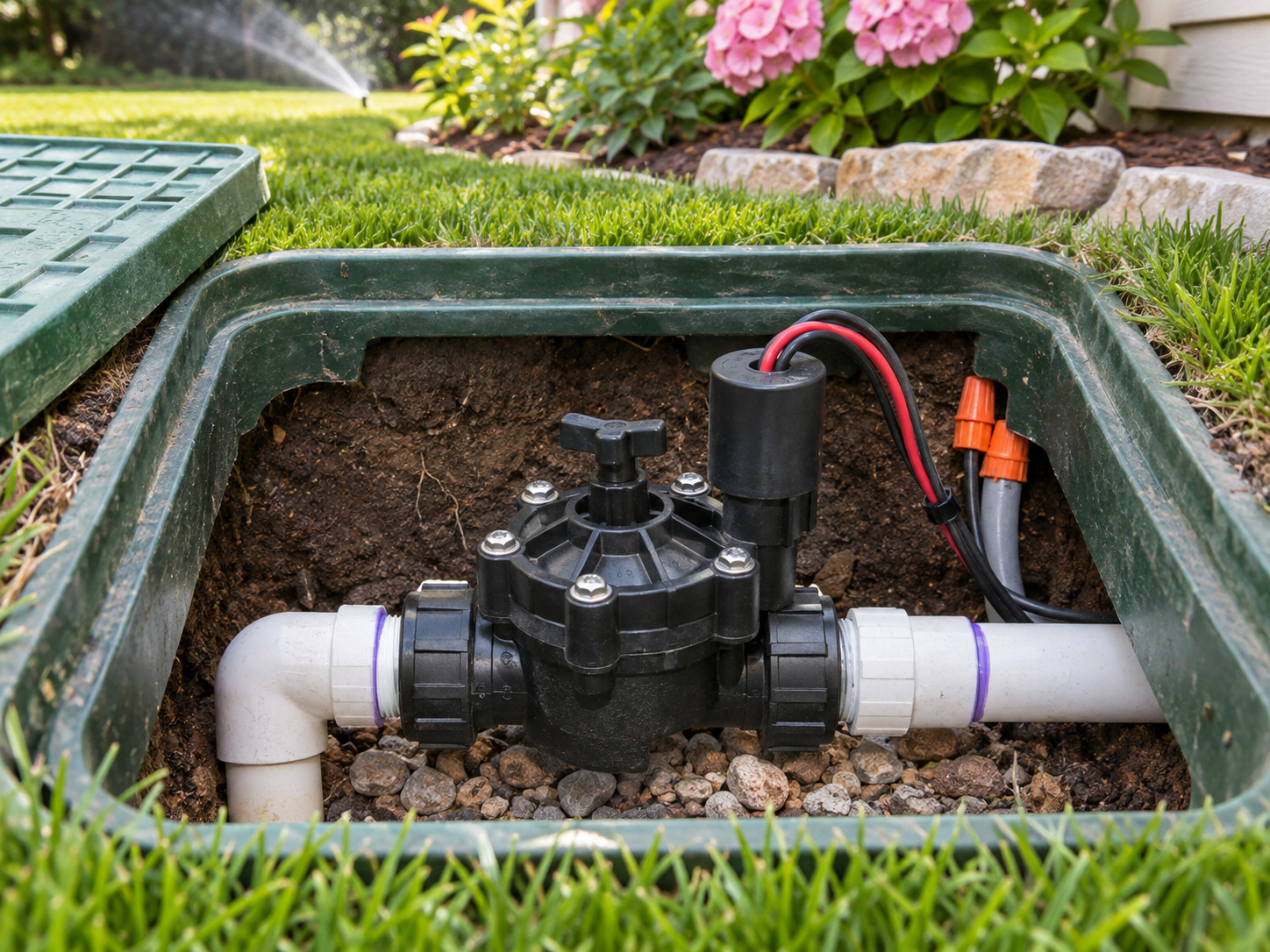
Irrigation zone valves are often installed underground inside protective valve boxes.
These enclosures help keep the valves organized while allowing access for maintenance.
Choosing an appropriate location is important.
A valve box should be placed where homeowners can reach it without removing permanent landscaping features.
Avoid locations where vehicles or heavy equipment may damage the enclosure.
The box should also be positioned to minimize unnecessary exposure to standing water.
Although irrigation valve boxes are designed for outdoor environments, excessive flooding or accumulated sediment can complicate maintenance.
Homeowners should consider how nearby landscaping may change over time.
Tree roots and expanding shrubs can eventually make valves difficult to access.
A well-planned installation allows enough room to inspect fittings, operate manual controls, and replace components when necessary.
Accessibility can make future repairs significantly easier.
Locate Underground Utilities Before Digging
Installing an irrigation zone valve may require excavation to expose existing piping or create space for a new valve box.
Before digging, homeowners should identify buried utilities.
Residential properties may contain natural gas lines, electrical cables, communication lines, water supply pipes, and other underground infrastructure.
In Montana, homeowners can contact Montana 811 before excavation to request utility marking.
However, certain privately installed lines may require separate locating services.
These can include private irrigation piping, landscape lighting cables, and other owner-installed infrastructure.
Homeowners should not assume that an area is safe for excavation simply because it is located within an existing garden.
Following appropriate utility-location procedures helps prevent accidental damage and serious safety hazards.
Careful planning also reduces the likelihood of unexpected installation delays.
Install the Valve in the Proper Flow Direction
Many irrigation zone valves are designed to allow water to travel through the valve in one specific direction.
The valve housing often includes an arrow indicating the required flow direction.
Installing the valve backward can interfere with its operation.
In some cases, the valve may fail to close correctly or may not open as intended.
Before connecting the valve, identify the inlet and outlet.
Compare the manufacturer’s instructions with the existing piping arrangement.
Do not assume that every valve has the same internal design.
Some models require particular orientations or clearances.
After installation, confirm that the valve is positioned correctly before restoring the water supply.
Following the intended flow direction helps prevent operating problems and unnecessary repairs.
Use Compatible Pipes and Fittings
An irrigation zone valve must connect securely to the water supply and distribution piping.
Depending on the system, these connections may involve threaded adapters, solvent-welded fittings, compression connections, or other approved methods.
The correct approach depends on the valve and pipe materials.
Homeowners should verify that all fittings are compatible before beginning installation.
Avoid forcing mismatched threads together.
Plastic valve housings can crack when threaded connections are overtightened.
Follow the manufacturer’s instructions for applying thread sealant or using other sealing components.
Some valve connections use O-rings or gaskets instead of conventional thread sealant.
The connected piping should also be properly supported.
A valve should not be forced into position between misaligned pipes.
Excessive mechanical stress can contribute to cracked fittings and leaks.
Correct installation helps maintain watertight connections throughout the watering season.
Protect the Water Supply With Proper Backflow Prevention
Backflow prevention is an important consideration for irrigation systems connected to household potable water supplies.
Irrigation equipment can come into contact with soil, fertilizers, pesticides, and other potential contaminants.
Under certain conditions, contaminated water may move backward toward the potable water supply if suitable protection is not present.
An irrigation zone valve is not a substitute for an approved backflow prevention assembly.
Although a zone valve controls normal water flow, it is not necessarily designed to prevent reverse flow or protect drinking water quality.
The appropriate backflow protection depends on the irrigation system and applicable plumbing requirements.
Homeowners should verify that the entire installation includes suitable safeguards.
The correct arrangement and placement of backflow prevention equipment can also affect where zone valves are installed.
A qualified plumber can help determine whether the water supply connection meets the appropriate requirements.
Understand How Irrigation Solenoids Operate
Many automatic irrigation zone valves use a solenoid to control the opening and closing process.
The solenoid receives an electrical signal from the irrigation controller.
This signal allows the valve’s internal mechanism to change position and regulate water flow.
Residential irrigation systems commonly use low-voltage controls, but electrical specifications vary by equipment.
Before installing a replacement valve, verify that its solenoid is compatible with the irrigation controller.
Using an incompatible solenoid may prevent the valve from operating.
Homeowners should also inspect the existing control wiring for visible damage.
Broken wires, corroded connections, or damaged insulation can cause intermittent operation.
Electrical connections should be made according to the manufacturer’s instructions using components suitable for the installation environment.
If wiring problems are extensive or the correct connection method is unclear, professional assistance may be appropriate.
Use Proper Waterproof Electrical Connections
Underground irrigation valve boxes are frequently exposed to moisture.
Rainwater, irrigation runoff, and condensation can affect electrical connections.
Improperly protected wiring may corrode over time.
This corrosion can increase electrical resistance or interrupt the signal between the controller and the valve.
When installing an automatic irrigation zone valve, use electrical connectors specifically rated for the intended irrigation environment.
Ordinary indoor wire connectors may not provide adequate protection.
Follow the manufacturer’s instructions for connecting and protecting the solenoid wires.
Keep wiring organized so that maintenance work does not accidentally pull connections apart.
Avoid leaving damaged insulation or exposed conductors inside the valve box.
Proper electrical connections help maintain reliable automatic watering performance.
Flush the Irrigation Line Before Connecting Sensitive Components
Debris can enter irrigation piping during installation or repair.
Small pieces of plastic, soil, sand, and other materials may become trapped inside the line.
If this debris enters an automatic zone valve, it may interfere with the internal diaphragm or sealing surfaces.
A valve contaminated by debris may fail to close completely.
This can allow water to continue moving into the irrigation zone after the controller has turned it off.
When appropriate for the system, flush the supply piping using the manufacturer’s recommended procedure before putting the valve into service.
Avoid directing contaminated flushing water into sensitive components.
Check the valve manufacturer’s instructions regarding any approved flushing or manual-bleed procedures.
Do not disassemble a pressurized valve.
Keeping debris out of the valve helps prevent premature wear and unreliable operation.
Avoid Excessive Pressure Changes
Sudden changes in water flow can create pressure fluctuations inside irrigation piping.
When moving water stops rapidly, a pressure surge may occur.
This condition is commonly associated with water hammer.
Depending on the piping arrangement and operating conditions, repeated pressure surges may stress valves and fittings.
Homeowners should use zone valves appropriate for the irrigation system’s pressure and flow requirements.
Avoid installing incompatible components that create unnecessary restrictions.
If pipes produce loud banging noises when irrigation zones close, the cause should be investigated.
Not every noise indicates a serious plumbing problem, but repeated pressure surges deserve attention.
A plumber can help assess whether the system requires modifications to reduce excessive pressure changes.
Proper system design helps protect valves, fittings, and water supply piping.
Consider the Needs of Drip Irrigation Zones
Drip irrigation zones often operate differently from conventional lawn sprinkler zones.
Drip systems may use lower flow rates and require pressure regulation and filtration.
If a standard irrigation valve is used with a low-flow drip zone, the valve must be suitable for that application.
Some automatic valves require a minimum flow rate to function correctly.
The system may also need a filter to protect small drip emitters from sediment.
A pressure regulator may be necessary to keep the downstream pressure within the tubing manufacturer’s limits.
Homeowners should evaluate the complete zone arrangement rather than selecting each component independently.
The valve, filter, pressure regulator, and irrigation tubing should operate together as a compatible system.
Proper planning helps prevent leaks, uneven watering, and equipment failure.
Test the Valve Before Backfilling
After installing a new irrigation zone valve, the system should be tested before the surrounding excavation is completed.
Restore water pressure according to the manufacturer’s instructions.
Inspect the inlet and outlet connections for leaks.
For automatic valves, activate the irrigation zone using the controller.
Confirm that the valve opens and water reaches the intended watering equipment.
Then turn the zone off.
Observe whether the valve closes properly.
If water continues flowing, investigate the cause.
Possible explanations include debris inside the valve, incorrect installation, electrical control problems, or damaged internal components.
Do not assume that every problem requires replacing the entire valve.
Identify the cause before making additional changes.
Testing while the installation remains accessible can help prevent unnecessary excavation later.
Recognize Signs of a Leaking Zone Valve
A leaking irrigation zone valve can waste water and affect landscaping.
One common symptom is water continuing to flow after the irrigation controller has ended the watering cycle.
Some systems may also experience water leaking from sprinkler heads at low points after a zone shuts off.
However, temporary drainage from low sprinkler heads is not always evidence of a defective valve.
Water remaining in the irrigation piping may drain naturally after operation.
Homeowners should distinguish between brief drainage and continuous unwanted flow.
Other warning signs include persistent moisture inside the valve box, unusually wet landscaping, and unexplained increases in water usage.
If a valve leaks continuously, shut off the affected water supply when appropriate and investigate the cause.
Prompt attention helps reduce water waste and prevent additional damage.
Understand Why a Zone Valve May Fail to Open
An irrigation zone that fails to activate may have a problem with its control valve.
However, several different conditions can cause the same symptom.
The irrigation controller may not be sending the correct signal.
A wire connection may be damaged.
The solenoid may have failed.
The valve may also be blocked by sediment or affected by inadequate water pressure.
Before replacing the valve, check the irrigation controller’s settings and any obvious signs of damage.
Follow the manufacturer’s troubleshooting instructions.
Avoid attempting electrical repairs without the necessary knowledge and equipment.
If the valve remains unresponsive, professional inspection can help determine whether the issue is electrical, mechanical, or related to the water supply.
Correct diagnosis can prevent unnecessary replacement costs.
Prepare Irrigation Zone Valves for Montana Winters
Winterization is essential for outdoor irrigation systems in Billings and Laurel.
Water trapped inside an irrigation valve can freeze as temperatures drop.
When water freezes, it expands and may damage the valve housing, diaphragm, or other internal components.
Even valves installed underground may be vulnerable if they are located above the effective frost-protection depth or remain filled with water.
Before winter, follow the irrigation system’s recommended winterization procedure.
Some systems require draining, while others may need a properly performed compressed-air blowout.
Compressed-air winterization must be completed according to the system manufacturer’s specifications and appropriate safety precautions.
Excessive air pressure or improper procedures can damage irrigation equipment and create injury risks.
Certain valves and backflow prevention assemblies may require specific preparation.
Homeowners should not assume that shutting off the water supply automatically removes all water from the valves.
Proper winterization helps reduce expensive spring repairs.
Inspect the Zone Valve Before Spring Startup
Before returning an irrigation system to regular operation, inspect the zone valves.
Look for cracks, leaks, loose connections, and damaged wiring.
Check that valve boxes remain accessible and are not filled with excessive soil or debris.
If standing water is present, determine whether it results from groundwater, surface drainage, or a plumbing leak.
Restore the water supply using the appropriate startup procedure.
Activate each irrigation zone individually.
Confirm that the valves open and close correctly.
Check for unexpected leaks around the valve connections.
If a valve fails to operate after winter, avoid forcing internal components.
Professional evaluation may be appropriate when the cause is unclear.
Spring inspections help identify problems before the irrigation system begins regular watering.
Maintain Irrigation Zone Valves Throughout the Growing Season
Routine maintenance can help extend the service life of irrigation zone valves.
Inspect valve boxes periodically.
Keep the surrounding area clear of excessive landscaping debris.
Check for visible leaks and unusual moisture.
For automatic systems, review irrigation controller settings and confirm that zones operate as scheduled.
If watering performance changes, investigate potential valve problems before adjusting the watering schedule.
A valve that does not close completely may allow unnecessary water flow.
A valve that fails to open may leave an entire irrigation zone without water.
Homeowners should also monitor connected filters and pressure regulators.
Problems with these components can affect valve operation.
Regular inspection helps identify small issues before they lead to larger plumbing repairs.
Know When Professional Plumbing Assistance Is Appropriate
Installing an irrigation zone valve may require changes to existing water supply piping, underground connections, or automatic control systems.
Professional assistance may be appropriate when the installation involves the household potable water supply, backflow prevention, or complicated pressure and flow requirements.
A plumber can help evaluate leaking connections, damaged piping, and unusual water pressure conditions.
Professional inspection may also be useful when a valve repeatedly fails despite replacement or routine maintenance.
In some situations, the underlying problem involves the system design rather than the valve itself.
Brown Plumbing & Heating can help homeowners in Billings and Laurel assess outdoor plumbing concerns and determine appropriate repair or installation options.
Keep Your Outdoor Irrigation System Reliable
An outdoor irrigation zone valve is an important part of controlling water distribution throughout a landscaped property.
When properly installed, the valve allows individual irrigation zones to operate according to their watering requirements.
However, reliable performance depends on selecting compatible equipment, maintaining appropriate water pressure, and using correctly installed fittings.
Homeowners should also consider backflow protection, accessible valve placement, waterproof electrical connections, and proper system testing.
In Billings and Laurel, Montana’s cold winters make irrigation winterization especially important.
Draining or otherwise preparing irrigation equipment according to the system’s requirements can help prevent frozen valves and damaged water supply connections.
Regular inspections during the growing season can also help identify leaks and operational problems before they become expensive repairs.
With careful planning and maintenance, irrigation zone valves can provide dependable watering control while helping protect outdoor plumbing systems.
For homeowners experiencing leaking irrigation connections, inconsistent water pressure, or damaged outdoor supply piping, Brown Plumbing & Heating can help evaluate the problem and recommend appropriate solutions.
Read Next: How to Prevent Plumbing Problems When Installing a New Outdoor Irrigation Master Valve
Read Next: How to Prevent Plumbing Problems When Installing a New Outdoor Irrigation Air Release Valve