How to Prevent Plumbing Problems When Installing a New Outdoor Irrigation Master Valve
A reliable irrigation system helps homeowners maintain healthy lawns, gardens, and landscaped areas throughout the growing season. For properties with automatic sprinkler systems, controlling when water enters the irrigation network is an important part of preventing leaks, unnecessary water usage, and equipment damage.
For homeowners in Billings and Laurel, Montana, installing an outdoor irrigation master valve can provide an additional level of water control. Unlike individual irrigation zone valves, which direct water to specific landscaping areas, a master valve controls the water supply feeding multiple irrigation zones.
When properly installed and configured, a master valve can help limit unwanted water flow when the irrigation system is not operating. However, incorrect installation can lead to pressure problems, leaking connections, malfunctioning sprinklers, and unnecessary plumbing repairs.
Understanding how irrigation master valves work, where they should be installed, and how they interact with other components can help homeowners protect their outdoor plumbing systems.
Brown Plumbing & Heating can help homeowners in Billings and Laurel evaluate outdoor water supply concerns and determine appropriate plumbing solutions for irrigation installations.
What Is an Outdoor Irrigation Master Valve?
An irrigation master valve is a control valve typically installed along the main water supply line feeding an irrigation system.
Its primary purpose is to control water flow to the irrigation network as a whole.
In many automatic systems, the master valve is connected to the irrigation controller.
When a watering cycle begins, the controller activates the master valve to allow water into the irrigation system.
Individual zone valves then control which areas receive water.
When the watering cycle ends, the controller closes the master valve, stopping the normal flow of water into the downstream irrigation piping.
This arrangement provides an additional level of control beyond individual zone valves.
However, a master valve is not a substitute for a manual emergency shutoff or an approved backflow prevention assembly.
Each component serves a different purpose.
Understanding these differences is important when planning a new installation.
Why Homeowners Install Irrigation Master Valves
Many residential irrigation systems use individual zone valves to manage watering schedules.
However, these valves may remain connected to a pressurized supply even when watering is not scheduled.
If a zone valve develops an internal leak or fails to close completely, water may continue entering the affected irrigation line.
A properly functioning master valve can help limit this problem by closing the main irrigation supply between watering cycles.
This may reduce unwanted water flow caused by certain downstream valve failures.
A master valve may also be useful for systems that include multiple irrigation zones or extensive underground piping.
However, it does not eliminate every potential source of water loss.
A leaking supply pipe located upstream of the master valve, for example, would not be protected by the master valve.
The valve’s effectiveness also depends on proper controller programming and reliable operation.
Homeowners should view a master valve as one component of a properly designed irrigation system rather than a guarantee against plumbing leaks.
Understand the Difference Between Master Valves and Zone Valves
Master valves and zone valves may look similar, but they perform different functions.
A zone valve controls water flow to one specific irrigation area.
For example, a residential system may have separate zones for front lawn sprinklers, backyard sprinklers, and garden drip irrigation.
Each zone valve opens when its corresponding watering schedule begins.
The master valve controls the water supply feeding the downstream irrigation network.
In a typical configuration, the master valve opens during a watering cycle and closes when the controller no longer requires irrigation.
This arrangement allows the system to control individual watering areas while limiting water delivery between scheduled cycles.
A master valve should not be confused with the manual shutoff valve used to isolate the irrigation system for maintenance.
Homeowners may still need a separate accessible shutoff for repairs, winterization, or emergencies.
The specific arrangement depends on the system design and applicable plumbing requirements.
Choose the Correct Master Valve
Selecting the appropriate master valve is essential for reliable performance.
The valve must be compatible with the irrigation supply pressure, expected water flow, piping materials, and controller.
Many residential systems use electrically operated diaphragm valves.
However, these valves are available in different sizes and configurations.
Some models are designed for higher flow applications, while others are better suited for smaller irrigation systems.
Before purchasing a valve, review the manufacturer’s specifications.
Verify the pressure rating, flow capacity, connection size, and control requirements.
A valve that is too small may restrict water flow and reduce sprinkler performance.
An oversized valve may not operate properly if the system does not provide the minimum flow or pressure conditions required by that model.
Choosing a suitable valve helps reduce operating problems and unnecessary replacement costs.
Evaluate the Available Water Pressure
Water pressure affects how master valves and downstream irrigation equipment operate.
If pressure is too low, the valve may not open or close as intended.
Insufficient pressure can also affect sprinkler coverage and drip irrigation performance.
Excessive pressure presents different concerns.
High pressure may place unnecessary stress on fittings, valve housings, and connected piping.
Before installation, determine the pressure available at the proposed connection point.
Consider both static pressure and operating pressure.
Static pressure is measured when water is not flowing, while operating pressure reflects conditions during irrigation.
Pressure losses through piping, filters, valves, and other components can affect the amount available to the sprinkler zones.
A master valve introduces some additional resistance to water flow.
The selected device should therefore be appropriate for the irrigation system’s pressure and flow requirements.
If pressure problems already exist, installing a master valve without addressing the underlying cause may make system performance worse.
A plumber can help determine whether the available supply is suitable.
Determine the Correct Valve Size
Valve size should be based on the irrigation system’s water demand rather than the physical size of the property alone.
A large lawn with several independently operated zones may have a different flow requirement than a smaller property where multiple sprinklers operate simultaneously.
The master valve should be able to handle the maximum flow expected during normal system operation.
If the valve is undersized, it may create excessive pressure loss.
This can reduce the water available to downstream irrigation zones.
However, selecting the largest available valve is not necessarily the correct solution.
Certain automatic valves have minimum operating flow requirements.
Homeowners should calculate or estimate the expected flow demand and compare it with the manufacturer’s specifications.
If the irrigation system may be expanded later, reasonable future capacity can be considered.
Proper sizing helps maintain reliable operation without introducing unnecessary restrictions.
Choose the Best Installation Location
The master valve is generally positioned on the irrigation supply line before the individual irrigation zone valves.
The exact location depends on the system layout, water supply connection, required backflow protection, and other components.
The valve should be accessible for maintenance and inspection.
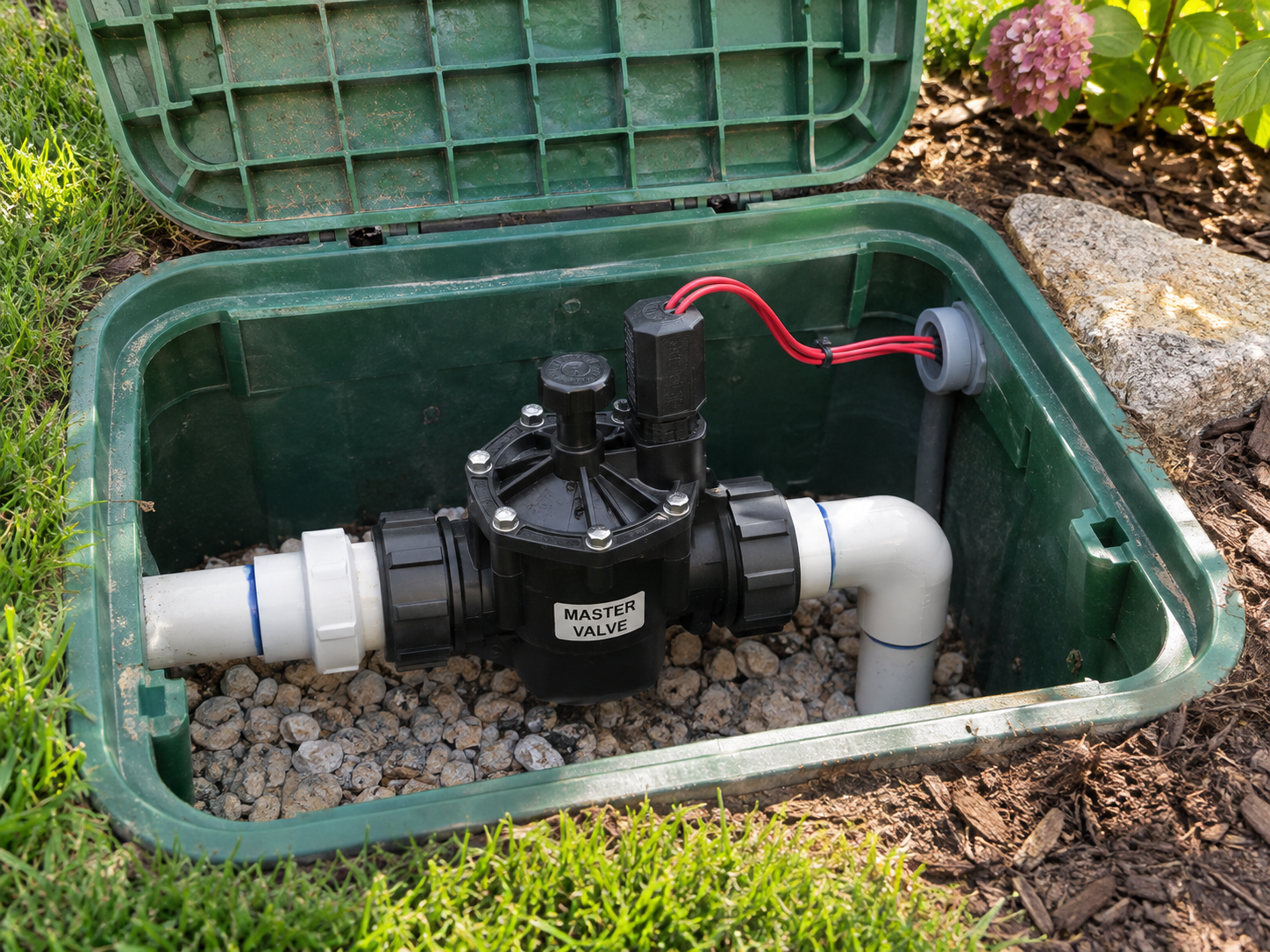
Many irrigation master valves are installed inside protective underground valve boxes.
These enclosures allow the valve to be reached without digging up the surrounding landscaping.
However, the box must provide sufficient clearance around the valve and fittings.
Avoid placing the valve beneath permanent structures, heavy equipment, or landscaping features that make access difficult.
Locations that regularly flood may also create maintenance problems.
The installation should allow the valve to be inspected and serviced without placing unnecessary stress on connected piping.
An accessible location makes future repairs easier and can reduce labor associated with maintenance.
Locate Underground Utilities Before Excavation
Installing a master valve may require excavation to access the irrigation main line.
Before digging, homeowners should identify existing underground utilities.
Residential properties may contain buried gas lines, electrical cables, communication lines, water supply piping, and other infrastructure.
In Montana, homeowners should contact Montana 811 before excavation to request utility marking.
Certain privately installed utilities may require additional locating services.
These can include privately owned irrigation lines, landscape lighting cables, and other underground connections.
Homeowners should never assume an area is safe to excavate simply because it is located within a lawn or garden.
Careful utility identification helps prevent accidental damage and serious safety hazards.
It can also help determine the safest location for the valve and its enclosure.
Install the Master Valve in the Correct Direction
Many irrigation master valves are designed for water to flow through them in one specific direction.
The valve body commonly includes an arrow indicating the intended flow path.
Installing the valve backward may prevent it from operating correctly.
In some cases, incorrect installation can interfere with the valve’s internal diaphragm or closing mechanism.
Before connecting the valve, identify the inlet and outlet.
Verify the installation orientation required by the manufacturer.
Some valves also have restrictions regarding horizontal or vertical mounting.
The connected piping should align correctly with the valve.
Avoid forcing the valve between pipes that are not properly positioned.
Once installed, confirm that the flow direction matches the irrigation supply arrangement.
Correct installation helps prevent mechanical problems and unnecessary repairs.
Use Compatible Plumbing Fittings
The master valve must be connected securely to the irrigation supply piping.
Depending on the materials and valve design, the installation may use threaded adapters, solvent-welded fittings, or other approved connections.
Homeowners should verify compatibility before installation.
Using mismatched fittings can create leaks or damage valve components.
Plastic valve housings can crack when threaded connections are overtightened.
Follow the manufacturer’s recommendations for sealing threaded fittings.
Some connections require specific thread sealants, while others use integrated sealing components.
The piping should also be supported appropriately.
A valve should not carry the weight of unsupported pipes or be subjected to unnecessary bending forces.
Before restoring normal water flow, inspect the completed connections.
Proper installation helps maintain watertight fittings and reduces the risk of underground leaks.
Keep Backflow Protection in Place
An irrigation master valve is not a backflow prevention device.
Its purpose is to control the normal flow of water into the irrigation system.
Backflow prevention equipment serves a separate function by protecting potable water from certain reverse-flow conditions.
Outdoor irrigation systems can come into contact with soil, fertilizers, pesticides, and other potential contaminants.
These conditions may require approved backflow protection.
The appropriate device and installation arrangement depend on applicable plumbing requirements and the irrigation system’s design.
Homeowners should not remove or bypass an existing backflow prevention assembly to install a master valve.
The location of the master valve must also be coordinated with the required backflow protection.
Some assemblies have specific installation and accessibility requirements.
A qualified plumber can help determine the appropriate arrangement for the water supply connection.
Protecting drinking water quality remains an essential consideration whenever irrigation equipment connects to household plumbing.
Understand How the Master Valve Connects to the Controller
Many automatic irrigation master valves operate through an electrical solenoid connected to the irrigation controller.
When a watering cycle begins, the controller sends a signal that activates the master valve.
The valve then allows water to enter the irrigation distribution system.
When watering finishes, the controller stops the signal according to its programming.
The valve should return to its normal closed position when operating as designed.
However, not every irrigation controller supports a dedicated master valve connection.
Before installation, verify that the controller has the appropriate capability.
The valve’s electrical specifications must also match the controller.
Homeowners should not assume that all irrigation solenoids are interchangeable.
Incorrect electrical connections can prevent the valve from operating.
A compatible controller and properly installed wiring are essential for dependable automatic operation.
Use Weather-Resistant Electrical Connections
Irrigation master valves are often installed outdoors or inside underground valve boxes.
These locations may be exposed to moisture, soil, and changing temperatures.
Electrical connections must be suitable for the environment.
Improperly protected wiring can corrode over time.
Corrosion or damaged wiring may interrupt the control signal, preventing the valve from opening or closing correctly.
Use connectors rated for the intended irrigation application.
Follow the manufacturer’s wiring instructions and applicable electrical requirements.
Avoid leaving exposed conductors or damaged insulation inside the valve box.
Wires should be arranged to reduce unnecessary pulling or tension during maintenance.
If wiring problems are extensive or the correct connection method is unclear, professional assistance may be appropriate.
Reliable electrical connections help prevent unexpected irrigation interruptions.
Program the Controller Correctly
Proper controller programming is necessary for a master valve to perform its intended function.
If the controller is not configured to activate the master valve, irrigation zones may fail to receive water.
Some controllers require the master valve function to be enabled in their settings.
Others automatically operate a connected master valve output during scheduled watering cycles.
The available features depend on the controller model.
Homeowners should review the controller’s instructions before installation.
Check that the master valve activates whenever a connected irrigation zone requires water.
Also verify that the valve closes when the system is no longer operating.
Special controller functions, including manual watering and maintenance programs, may need additional consideration.
Correct programming helps ensure the master valve and individual zone valves work together.
Understand the Role of Flow Sensors
Some irrigation systems use flow sensors to monitor the amount of water moving through the system.
A flow sensor and master valve can work together when supported by a compatible irrigation controller.
For example, a controller may be able to identify unusually high flow during a watering cycle.
Depending on its capabilities, the controller may then close the master valve or generate an alert.
However, not every controller includes flow monitoring or automatic leak response.
A standard master valve does not independently detect leaks.
It simply opens and closes in response to its controls.
Homeowners interested in additional leak monitoring should verify that the controller, sensor, and valve are designed to work together.
Correct configuration is essential.
Flow monitoring can provide useful information, but it should not replace routine inspections or proper maintenance.
Prevent Debris From Damaging the Valve
Dirt, sand, and other debris can interfere with the internal components of irrigation master valves.
Many automatic valves use a flexible diaphragm and internal passages to control water movement.
If debris becomes trapped around the sealing surfaces, the valve may fail to close completely.
This can allow unwanted water flow into the downstream irrigation piping.
During installation, prevent soil and construction debris from entering open pipes.
When appropriate, flush the piping using the manufacturer’s recommended procedure before placing the valve into service.
Avoid directing contaminated water through sensitive equipment.
If the system includes filtration, maintain those components according to the manufacturer’s instructions.
Repeated debris problems may indicate a need to investigate the water supply or piping condition.
Keeping the valve clean helps maintain reliable operation.
Test the Master Valve Before Completing Installation
Testing is an important step before closing the valve box or completing any required backfilling.
After installing the valve, restore water pressure according to the manufacturer’s instructions.
Inspect all connections for leaks.
Activate an irrigation zone using the controller.
Confirm that the master valve opens and water reaches the intended watering area.
Repeat the process with other irrigation zones as necessary.
When watering ends, verify that the master valve closes.
If the irrigation zones do not receive water, investigate the electrical connections, controller configuration, and valve operation.
If water continues flowing after the controller has shut down, the valve may not be sealing properly.
Correct any problems before leaving the system unattended.
Testing helps identify installation issues before they become more difficult to repair.
Recognize Signs of a Malfunctioning Master Valve
A failing master valve can affect several irrigation zones at the same time.
One possible warning sign is that no irrigation zones receive water even though the controller appears to be operating.
This may indicate that the master valve is not opening.
However, the problem could also involve the water supply, controller wiring, or another component.
Another warning sign is continuous water flow when the irrigation system should be inactive.
This may indicate a valve that is not closing properly.
Homeowners may also notice unusually wet ground around the valve box or unexplained water usage.
These conditions deserve investigation.
Before replacing the valve, identify whether the problem is electrical, mechanical, or related to the water supply.
Correct diagnosis can prevent unnecessary repairs.
Avoid Confusing the Master Valve With the Main Shutoff
A master valve should not be treated as the only means of shutting off water to the irrigation system.
Automatic valves depend on internal components and, in many installations, electrical controls.
A separate manual shutoff is generally important for isolating the irrigation supply during maintenance or emergencies.
The arrangement should be designed according to applicable requirements.
Homeowners should know where the manual irrigation shutoff is located.
If a master valve develops a leak or must be replaced, the upstream water supply may need to be isolated.
An accessible shutoff can make repairs safer and more convenient.
It is also important during seasonal winterization.
Understanding the function of each valve helps homeowners respond more effectively to plumbing problems.
Prepare the Master Valve for Montana Winters
Outdoor irrigation equipment in Billings and Laurel must be protected from freezing temperatures.
Water trapped inside a master valve can freeze and expand.
This expansion may damage the valve body, internal diaphragm, or connected fittings.
An underground valve box does not automatically provide freeze protection.
Depending on the installation depth and conditions, the valve may still be vulnerable during cold weather.
Before winter, the irrigation system should be winterized according to its design and the manufacturer’s instructions.
This may involve draining the piping, isolating the water supply, or using an approved professional winterization procedure.
Some systems require compressed-air blowouts, which must be performed using appropriate equipment and safety precautions.
Improper procedures can damage valves, backflow prevention assemblies, and other irrigation components.
Homeowners should confirm whether the master valve requires specific winterization steps.
Proper preparation can reduce the likelihood of expensive spring repairs.
Inspect the Master Valve During Spring Startup
Before returning the irrigation system to regular use, inspect the master valve and surrounding connections.
Look for cracks, visible leaks, damaged wiring, and loose fittings.
Check the valve box for excessive sediment or standing water.
Standing water may indicate a plumbing leak, although surface drainage or groundwater can also contribute.
Restore water pressure using the appropriate startup procedure.
Activate the irrigation system and verify that the master valve operates correctly.
Inspect the valve while the system is running.
Check that it closes when watering ends.
If the master valve fails to operate, review the controller settings and accessible wiring according to the manufacturer’s instructions.
Professional inspection may be appropriate when the cause is unclear.
Spring maintenance helps identify winter damage before regular watering begins.
Maintain the Master Valve Throughout the Growing Season
Routine maintenance helps preserve reliable operation.
Inspect the valve box periodically for moisture, debris, and physical damage.
Verify that electrical connections remain protected.
Observe irrigation operation to confirm that the master valve opens and closes as expected.
If multiple irrigation zones suddenly experience poor water flow, consider whether the master valve is contributing to the problem.
However, low flow may also result from supply restrictions, clogged filtration equipment, or other system conditions.
Homeowners should investigate the cause before replacing components.
Keep the valve accessible for servicing.
Avoid allowing soil, mulch, or landscaping materials to cover the enclosure.
Regular inspections can help identify small problems before they affect the entire irrigation system.
Know When Professional Plumbing Assistance Is Necessary
Installing an irrigation master valve may involve modifications to the main irrigation supply, underground piping, electrical controls, and other plumbing components.
Professional assistance may be appropriate when the system requires a new connection, significant changes to existing piping, or evaluation of water pressure and flow.
A plumber can also help assess leaking fittings, damaged supply lines, and concerns involving backflow protection.
If a master valve repeatedly malfunctions or several irrigation zones experience similar problems, professional inspection may help determine whether the issue involves the valve or the overall system design.
Brown Plumbing & Heating can help homeowners in Billings and Laurel evaluate outdoor plumbing concerns and determine appropriate repair or installation solutions.
Keep Your Irrigation System Protected and Reliable
An outdoor irrigation master valve can provide an additional level of control over the water entering a residential irrigation system.
When properly selected, installed, and configured, the valve can help limit unwanted downstream water flow between scheduled watering cycles.
However, dependable operation requires careful planning.
Homeowners should choose a compatible valve, evaluate supply pressure and flow requirements, and install the equipment in an accessible location.
Correct fittings, appropriate backflow protection, reliable electrical connections, and proper controller programming are also important.
For properties in Billings and Laurel, Montana’s cold winters make irrigation winterization especially important.
Routine inspections and seasonal maintenance can help prevent leaks, damaged components, and unexpected irrigation failures.
With proper installation and maintenance, an irrigation master valve can help homeowners manage outdoor watering while protecting their plumbing systems.
For homeowners experiencing irrigation supply leaks, pressure problems, or damaged outdoor water connections, Brown Plumbing & Heating can help evaluate the situation and recommend appropriate solutions.
Read Next: How to Prevent Plumbing Problems When Installing a New Outdoor Irrigation Zone Valve