How to Prevent Plumbing Problems When Installing a New Outdoor Irrigation Rain Sensor
A properly maintained irrigation system helps homeowners keep their lawns, gardens, and landscaped areas healthy throughout the growing season. However, watering when the ground has already received sufficient rainfall can waste water, increase utility costs, and create unnecessary moisture problems around a property.
For homeowners in Billings and Laurel, Montana, installing an outdoor irrigation rain sensor can help reduce unnecessary watering by preventing compatible automatic sprinkler systems from operating during certain wet weather conditions.
A rain sensor detects rainfall and communicates with an irrigation controller to temporarily interrupt scheduled watering. When conditions become sufficiently dry, the sensor allows the irrigation system to resume its normal schedule.
Although rain sensors are relatively small devices, improper installation can lead to unreliable operation, unnecessary watering, or irrigation schedules that fail to activate when needed.
Understanding how irrigation rain sensors work, where they should be installed, and how to maintain them can help homeowners protect their landscaping and improve outdoor water management.
Brown Plumbing & Heating can help homeowners in Billings and Laurel evaluate outdoor water supply concerns and determine appropriate plumbing solutions for irrigation systems.
Why Homeowners Install Outdoor Irrigation Rain Sensors
Automatic irrigation systems are designed to water lawns and landscaping according to programmed schedules.
However, traditional irrigation controllers may continue operating even when recent rainfall has provided adequate moisture.
This can result in unnecessary water usage.
Excessive watering may also contribute to standing water, soil erosion, and drainage problems.
In certain situations, repeated overwatering near a building can increase moisture around the foundation.
An irrigation rain sensor helps reduce unnecessary watering by interrupting scheduled irrigation when rainfall reaches a designated threshold.
This can help homeowners avoid watering during or shortly after some rain events.
However, a rain sensor does not directly measure how much water plant roots receive.
It responds to rainfall conditions at the sensor’s location.
Homeowners should continue monitoring their landscaping and adjusting watering schedules based on seasonal conditions.
Understanding How an Irrigation Rain Sensor Works
An irrigation rain sensor detects rainfall and sends information to a compatible irrigation controller.
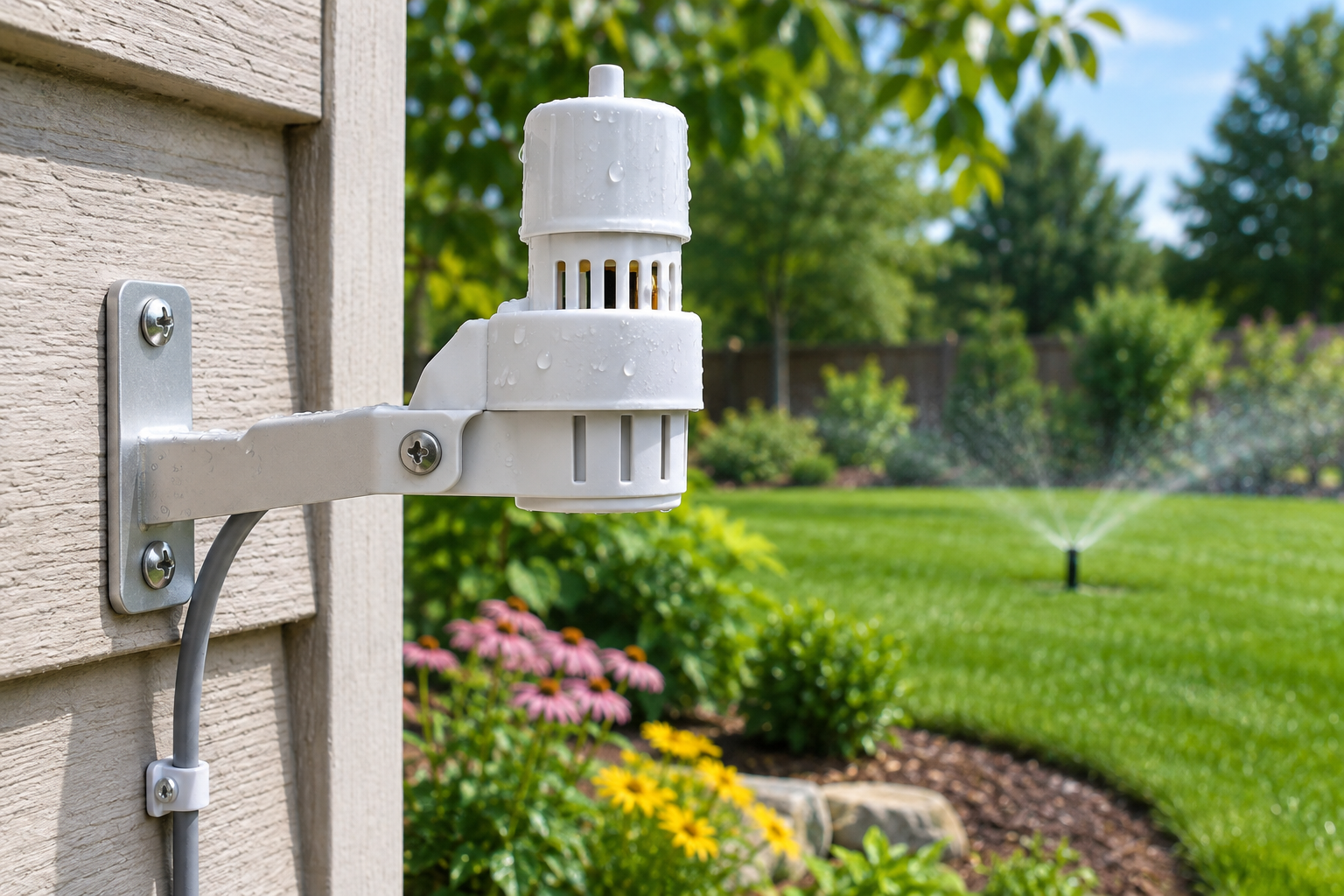
Many residential rain sensors use moisture-sensitive discs that expand when exposed to water.
As the discs absorb moisture, they activate a mechanism that signals the controller to suspend irrigation.
Once the discs dry sufficiently, the mechanism returns to its normal operating position.
The irrigation controller can then resume watering according to its programmed schedule.
Some rain sensors use alternative detection technologies.
Wireless models transmit information to a compatible receiver or controller.
Wired models communicate through electrical connections.
The exact operation depends on the sensor and controller design.
Homeowners should review the manufacturer’s instructions to understand how their selected equipment detects rainfall and restores irrigation operation.
Choose a Rain Sensor Compatible With the Irrigation Controller
One of the most important steps is confirming compatibility between the rain sensor and the existing irrigation controller.
Not every sensor works with every controller.
Some irrigation controllers include dedicated terminals for rain sensors.
Others require particular wiring configurations or compatible receiver modules.
Certain controllers support wireless sensors, while others are designed primarily for wired connections.
Before purchasing equipment, identify the controller’s manufacturer and model.
Review its documentation to determine which sensor types are supported.
The electrical characteristics of the sensor must also be compatible with the controller.
Some sensors use normally closed switching arrangements, while others may operate differently.
Installing an incompatible sensor can prevent irrigation from operating correctly.
Homeowners should avoid assuming that all rain sensors are interchangeable.
Selecting compatible equipment helps reduce installation problems and unreliable watering schedules.
Understand the Difference Between Wired and Wireless Rain Sensors
Outdoor irrigation rain sensors are commonly available in wired and wireless configurations.
Wired sensors communicate with the irrigation controller through electrical cable.
These systems may be appropriate when the sensor can be installed within a reasonable distance of the controller and the wiring can be routed safely.
Wireless sensors transmit information to a compatible receiver or directly to a supported controller.
Wireless models may simplify installation when running a cable would be difficult.
However, wireless equipment may require batteries or other manufacturer-specified power sources.
The effective communication range can also depend on walls, landscaping, building materials, and other obstacles.
Homeowners should consider the installation location and available controller connections before choosing a sensor.
Neither type is automatically superior for every property.
A properly installed wired sensor can provide dependable operation, while a compatible wireless sensor may offer greater placement flexibility.
The best choice depends on the property and irrigation system.
Select a Location With Unobstructed Rainfall Exposure
Rain sensor location is essential for accurate operation.
A sensor installed beneath a roof overhang may not receive the same rainfall as the surrounding lawn.
Similarly, a sensor located beneath dense tree branches may be shielded from some precipitation.
The sensor should generally be installed in an exposed location where it can detect natural rainfall.
However, it should also be positioned away from sprinkler spray.
If irrigation sprinklers repeatedly wet the sensor, the device may incorrectly interpret that moisture as rainfall.
This can cause the system to suspend watering unexpectedly.
Homeowners should also avoid locations exposed to excessive runoff from roofs or gutters.
Water dripping from a roof edge may cause the sensor to remain wet longer than the surrounding landscape.
Follow the manufacturer’s placement recommendations when selecting a mounting location.
Correct positioning helps the sensor respond more accurately to weather conditions.
Avoid Installing the Sensor Near Sprinkler Heads
An irrigation rain sensor should detect natural rainfall rather than water from the irrigation system itself.
If a nearby sprinkler head sprays directly onto the sensor, the device may activate during a normal watering cycle.
This can interrupt scheduled irrigation even when no rain has occurred.
Before installation, identify the locations and spray patterns of nearby sprinklers.
Consider how sprinkler coverage changes with wind conditions.
A sensor that appears outside a sprinkler’s range during calm weather may still receive spray when the wind shifts.
Homeowners should choose a location that minimizes exposure to irrigation water.
The sensor should also be positioned where maintenance activities will not accidentally redirect sprinklers toward it.
Proper placement helps prevent false rain detection and inconsistent watering schedules.
Choose a Secure Mounting Surface
Rain sensors must remain properly positioned to detect rainfall consistently.
Many models include brackets designed for mounting to suitable exterior structures.
Depending on the product, a sensor may be installed on a fence post, building trim, or another approved mounting surface.
The mounting location should be stable.
A loose bracket may allow the sensor to tilt or move during strong winds.
This can interfere with its operation or expose the equipment to damage.
Homeowners should use mounting hardware appropriate for the selected surface.
If the installation requires attaching the bracket to an exterior wall, take care to protect the building from moisture intrusion.
Fastener penetrations should be detailed according to the surface material and applicable installation instructions.
Avoid damaging siding, flashing, or other weather-resistant building components.
Secure mounting helps maintain reliable sensor operation.
Understand Adjustable Rainfall Settings
Some irrigation rain sensors allow homeowners to select the amount of rainfall required before watering is interrupted.
These devices may include adjustable settings corresponding to different rainfall thresholds.
The correct setting depends on the sensor design, landscaping conditions, and irrigation requirements.
A sensor configured to respond to very small amounts of rainfall may interrupt watering frequently.
A higher threshold may allow irrigation to continue during lighter rain events.
Homeowners should follow the manufacturer’s instructions when adjusting the sensor.
It is also important to understand that rainfall thresholds do not directly measure soil moisture.
A short rainstorm may activate the sensor without providing enough water to reach deeper plant roots.
Similarly, soil may remain moist after the sensor has dried.
Rain sensors are helpful irrigation management tools, but watering schedules should still reflect the actual needs of the landscaping.
Consider the Sensor’s Drying Time
Many mechanical rain sensors use moisture-sensitive components that require time to dry after rainfall.
This drying process determines when the sensor allows irrigation to resume.
Some models include adjustable ventilation openings that influence how quickly the sensor dries.
The appropriate setting depends on the equipment and local conditions.
A sensor that dries too quickly may allow irrigation to restart while the landscape still has sufficient moisture.
A sensor that remains wet for an extended period may delay watering longer than necessary.
Homeowners should review the manufacturer’s instructions before adjusting drying settings.
Avoid modifying the sensor in ways that could interfere with its intended operation.
The goal is to provide a reasonable response to rainfall while maintaining appropriate irrigation for the property.
Protect Electrical Wiring From Outdoor Conditions
Wired rain sensors require electrical connections between the sensor and the irrigation controller.
These connections must be installed correctly to ensure reliable communication.
Outdoor wiring may be exposed to sunlight, moisture, temperature changes, and physical damage.
Damaged insulation or corroded connections can prevent the controller from receiving the correct sensor signal.
Use wiring and connectors suitable for the intended environment.
Follow the manufacturer’s instructions regarding cable type, routing, and connection methods.
Avoid leaving exposed conductors or improperly protected splices outdoors.
Wiring should also be secured so that wind, landscaping tools, or normal property maintenance do not pull connections loose.
If cables pass through a building wall, the penetration should be properly protected against moisture.
Reliable wiring helps prevent unnecessary irrigation interruptions and troubleshooting problems.
Configure the Irrigation Controller Correctly
Installing a rain sensor does not guarantee that the irrigation controller will automatically recognize it.
Some controllers require the rain sensor function to be enabled in the settings.
Others use dedicated sensor terminals or compatible receiver equipment.
Homeowners should follow the controller manufacturer’s installation and configuration instructions.
If the sensor is connected incorrectly, the controller may continue watering despite rainfall.
In other situations, incorrect wiring may prevent irrigation zones from operating.
Some controllers include a sensor bypass function.
This feature may allow watering to continue temporarily when the sensor would otherwise interrupt irrigation.
Homeowners should understand when the bypass is active and restore normal sensor operation when appropriate.
Correct configuration helps ensure that the sensor and irrigation controller work together as intended.
Do Not Confuse Rain Sensors With Soil Moisture Sensors
Rain sensors and soil moisture sensors are both used in irrigation management, but they measure different conditions.
A rain sensor detects rainfall at its installation location.
A soil moisture sensor measures moisture conditions in the soil where the device is installed.
This distinction is important.
A rain sensor may stop scheduled irrigation following rainfall even if some protected or unusually dry planting areas still require water.
A soil moisture sensor may provide more direct information about moisture within a particular section of the landscape.
However, soil moisture sensors have their own installation and calibration requirements.
Some irrigation systems use weather-based controllers, soil moisture sensors, or combinations of monitoring equipment.
Homeowners should choose equipment based on the landscaping’s needs and controller compatibility.
Understanding the differences helps prevent unrealistic expectations about what a rain sensor can accomplish.
Protect Irrigation Plumbing From Unnecessary Watering
Although a rain sensor is not installed directly inside the water supply piping, it can influence how frequently irrigation plumbing operates.
Reducing unnecessary watering cycles may help limit avoidable water use.
It can also reduce the amount of time sprinklers and irrigation valves are actively operating.
However, a rain sensor does not repair leaking pipes or prevent all plumbing failures.
If an underground supply line leaks continuously, interrupting scheduled irrigation may not stop the leak.
The result depends on where the damaged pipe is located and how the system is controlled.
Homeowners should continue inspecting irrigation piping, valves, and sprinkler heads for problems.
A properly functioning rain sensor can support better watering management, but it is not a substitute for regular plumbing maintenance.
Understand the Relationship Between Rain Sensors and Master Valves
A rain sensor and an irrigation master valve perform different functions.
The rain sensor communicates rainfall conditions to the irrigation controller.
A master valve controls water flow into the downstream irrigation network when activated by a compatible controller.
When properly configured, a rain sensor may prevent the controller from starting scheduled watering cycles.
If the controller also operates a master valve, the master valve may remain closed during those skipped cycles.
However, this behavior depends on the controller and system configuration.
A rain sensor does not independently operate every type of master valve.
It also does not automatically detect leaks or abnormal water flow.
Homeowners should verify how their selected equipment interacts before relying on automatic watering interruption.
Understanding the relationship between these components helps prevent confusion during installation and troubleshooting.
Test the Rain Sensor After Installation
Testing is an important step before relying on a newly installed rain sensor.
The manufacturer’s instructions should provide an appropriate method for checking operation.
Some rain sensors include a test mechanism that simulates rainfall activation.
Others can be tested using a manufacturer-approved procedure.
Homeowners should first verify that the irrigation controller recognizes the sensor.
Then confirm that the controller responds appropriately when the sensor indicates wet conditions.
If the equipment supports a status display, check whether it reports the expected sensor condition.
After the test, verify that normal operation can resume.
Do not assume that the sensor is functioning simply because it is physically connected.
A properly tested installation reduces the chance of unnecessary watering or unexpected irrigation interruptions.
Recognize Signs of a Malfunctioning Rain Sensor
A rain sensor may develop problems as components age or become damaged.
One warning sign is an irrigation system that continues watering during rainfall despite being configured to respond to the sensor.
Another possible symptom is a system that remains suspended long after the sensor should have dried.
However, these conditions may also result from incorrect controller settings, damaged wiring, or an active bypass function.
Homeowners should investigate the cause before replacing the sensor.
Check for obvious physical damage, loose connections, or debris obstructing the sensing mechanism.
For wireless models, inspect the battery or power source according to the manufacturer’s instructions.
If troubleshooting does not resolve the issue, replacement or professional evaluation may be appropriate.
Correct diagnosis helps prevent unnecessary equipment purchases.
Keep the Sensor Free From Debris
Outdoor rain sensors are exposed to leaves, dust, pollen, and other environmental materials.
Debris can accumulate around the sensing mechanism or ventilation openings.
If the sensor becomes obstructed, it may not respond to rainfall as intended.
Homeowners should inspect the device periodically.
Remove leaves, cobwebs, and other debris according to the manufacturer’s maintenance instructions.
Avoid using harsh cleaning chemicals or tools that could damage sensitive components.
Some models include removable covers that allow limited cleaning.
Follow the manufacturer’s instructions before disassembling any part of the sensor.
Keep nearby vegetation trimmed so that branches do not obstruct rainfall.
Regular cleaning can help maintain accurate operation throughout the growing season.
Consider the Effects of Montana Weather
Weather conditions in Billings and Laurel can change significantly throughout the year.
Spring and summer may bring rainfall, thunderstorms, and periods of dry weather.
These changes make effective irrigation scheduling important.
However, homeowners should remember that rain sensors are primarily designed to detect rainfall rather than every type of weather condition.
A standard rain sensor does not necessarily detect freezing temperatures.
Some products include additional freeze detection features, but these capabilities depend on the model.
A sensor without freeze detection should not be relied upon to prevent irrigation during freezing weather.
Likewise, a rain sensor does not replace proper winterization of outdoor plumbing.
Homeowners should select equipment based on its actual capabilities and the property’s needs.
Understanding these limitations helps ensure that the irrigation system is operated appropriately throughout the season.
Prepare the Rain Sensor for Winter
Most residential irrigation systems in Billings and Laurel require winter preparation because freezing temperatures can damage water-filled piping and valves.
A rain sensor is not a substitute for winterization.
The irrigation water supply must still be shut off, drained, or otherwise prepared according to the system’s requirements.
The rain sensor itself may also require seasonal attention.
Some models are designed to remain outdoors throughout winter.
Others may have specific maintenance or storage recommendations.
Homeowners should review the manufacturer’s instructions.
For wireless sensors, battery condition may also deserve attention before and after extended periods of inactivity.
Avoid assuming that a rain sensor will automatically prevent frozen irrigation pipes.
The device is primarily intended to help manage watering during rainfall, not provide complete freeze protection.
Inspect the Rain Sensor Before Spring Startup
Before the spring irrigation season begins, inspect the rain sensor for visible damage.
Check the mounting bracket and confirm that the device remains securely positioned.
Remove accumulated debris.
Inspect wiring and connectors for deterioration.
For wireless models, verify that the battery and communication system are functioning according to the manufacturer’s instructions.
Review the irrigation controller’s sensor settings.
Confirm that the sensor has not been accidentally bypassed.
Perform the recommended operational test.
Once the system is functioning properly, observe its behavior during normal irrigation cycles.
Spring inspections can help identify problems before the watering season becomes more demanding.
Maintain the Entire Irrigation System
A rain sensor can help reduce unnecessary watering, but the rest of the irrigation system still requires regular maintenance.
Homeowners should inspect sprinkler heads for damage and improper spray patterns.
Check irrigation valve boxes for leaks and standing water.
Examine accessible pipes and fittings for deterioration.
Monitor watering schedules to ensure that each landscaping area receives an appropriate amount of water.
If a zone repeatedly becomes oversaturated, investigate whether the issue involves excessive watering time, drainage conditions, or malfunctioning equipment.
A rain sensor may reduce watering after rainfall, but it cannot correct every cause of overwatering.
Maintaining the complete irrigation system helps improve reliability and reduce unnecessary water usage.
Know When Professional Assistance Is Appropriate
Installing a rain sensor may be relatively straightforward when it connects to a compatible irrigation controller using the manufacturer’s instructions.
However, some systems involve complicated wiring, multiple controllers, master valves, or additional monitoring equipment.
Professional assistance may be appropriate when the controller does not recognize the sensor or the irrigation system behaves unexpectedly after installation.
A technician familiar with the equipment may be needed to troubleshoot control compatibility or electrical connections.
If the irrigation system also experiences leaking valves, unusual water pressure, or damaged supply piping, plumbing inspection may be necessary.
Brown Plumbing & Heating can help homeowners in Billings and Laurel evaluate outdoor water supply problems and determine appropriate plumbing repair or installation options.
Improve Watering Efficiency With Proper Rain Sensor Installation
An outdoor irrigation rain sensor can be a useful addition to an automatic sprinkler system.
By detecting rainfall and communicating with a compatible controller, it can help prevent unnecessary watering during certain wet weather conditions.
However, reliable operation requires proper equipment selection and installation.
Homeowners should choose a sensor compatible with their irrigation controller, install it in a suitable location, and protect any required electrical connections.
Correct mounting, controller configuration, and operational testing are equally important.
In Billings and Laurel, changing seasonal conditions make regular irrigation maintenance and winter preparation especially important.
A rain sensor can support responsible water management, but homeowners should continue checking their landscaping, irrigation valves, and water supply connections for problems.
With careful installation and maintenance, an irrigation rain sensor can help reduce unnecessary water usage while supporting a dependable outdoor watering system.
For homeowners experiencing irrigation leaks, pressure problems, damaged outdoor water connections, or other plumbing concerns, Brown Plumbing & Heating can help assess the situation and recommend appropriate solutions.
Read Next: How to Prevent Plumbing Problems When Installing a New Outdoor Irrigation Flow Sensor