How to Prevent Plumbing Problems When Installing a New Outdoor Irrigation Flush Valve
A properly maintained irrigation system helps homeowners keep lawns, gardens, and landscaped areas healthy throughout the growing season. However, even well-designed irrigation systems can experience problems when sediment, dirt, and other debris accumulate inside water lines.
For homeowners in Billings and Laurel, Montana, installing an outdoor irrigation flush valve can make routine system maintenance easier. These valves provide a controlled way to release water and accumulated debris from irrigation piping, helping reduce clogged emitters, restricted water flow, and unnecessary plumbing repairs.
Although irrigation flush valves are relatively small components, choosing the wrong valve or installing one incorrectly can lead to leaks, water waste, pressure problems, and damaged irrigation equipment.
Understanding how flush valves work, where they should be installed, and how to maintain them can help homeowners protect their outdoor watering systems.
Brown Plumbing & Heating can help homeowners in Billings and Laurel evaluate outdoor plumbing concerns and determine appropriate solutions for irrigation water supply connections.
Why Irrigation Systems Need Flush Valves
Outdoor irrigation systems carry water through pipes, tubing, fittings, and watering devices.
Over time, small particles may enter the system through the water supply, installation work, or maintenance activities.
These particles can collect in low-flow areas or become trapped inside irrigation tubing.
Drip irrigation systems are particularly sensitive to debris because their emitters have small water passages.
When particles accumulate, some emitters may become partially or completely blocked.
This can cause uneven watering and unnecessary stress on plants.
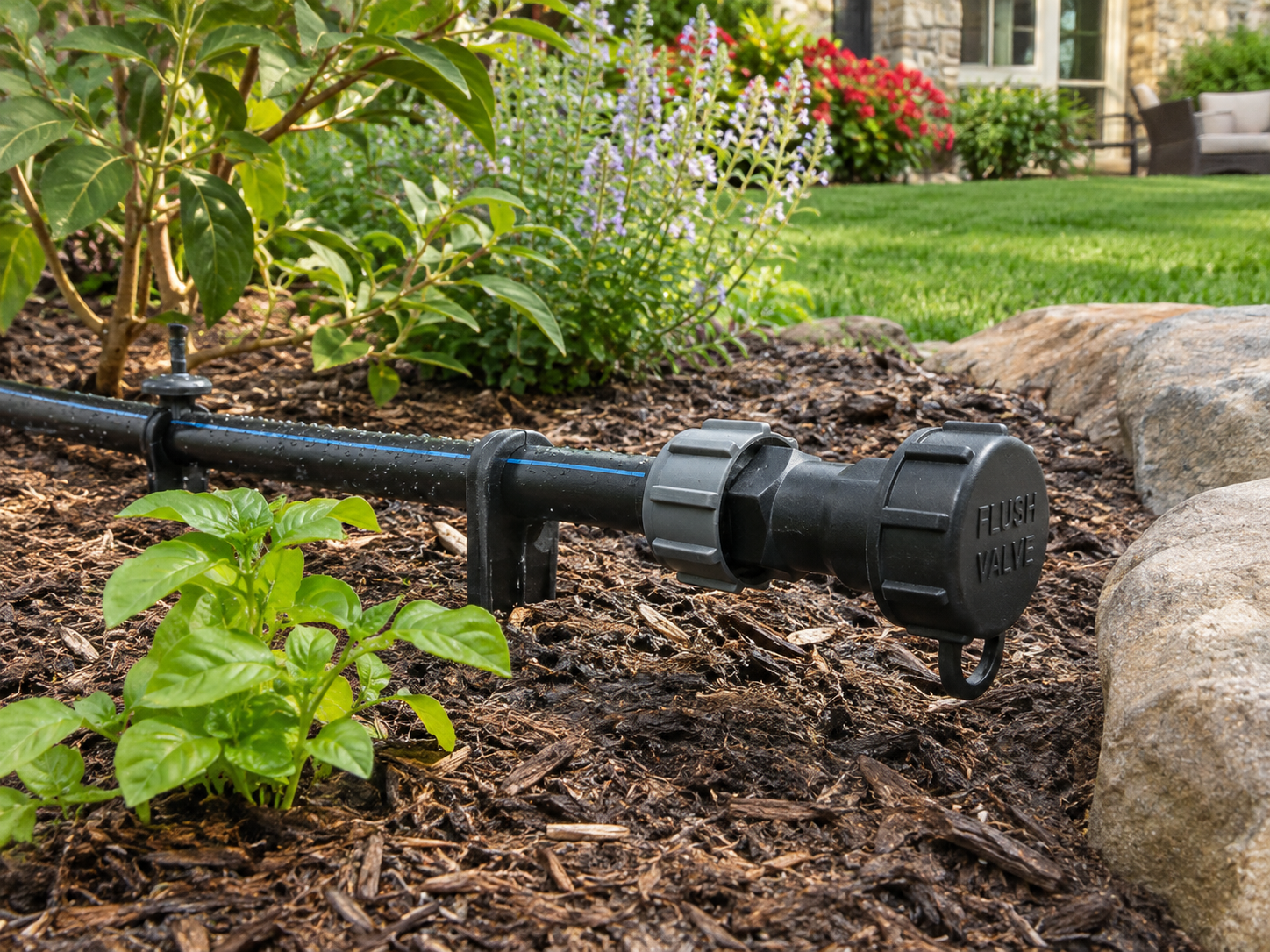
An irrigation flush valve provides an opening where water can carry accumulated debris out of the irrigation line.
By allowing the system to be flushed periodically, homeowners can help maintain cleaner piping and more consistent water distribution.
However, a flush valve does not replace proper filtration.
Both components serve different purposes and may be needed to keep irrigation equipment functioning reliably.
Understanding How an Irrigation Flush Valve Works
An irrigation flush valve allows water to exit an irrigation line through a designated discharge point.
Many flush valves are installed near the end of drip irrigation tubing or at another location specified by the irrigation system design.
When the valve opens, flowing water helps carry loose sediment and debris out of the line.
Manual flush valves must be opened and closed by the homeowner or maintenance technician.
Automatic flush valves perform this function under particular operating conditions.
Some automatic flushing devices open briefly when irrigation begins and close as pressure increases.
Other designs operate differently.
The appropriate valve depends on the irrigation system and the manufacturer’s specifications.
Homeowners should not assume that every automatic flush valve functions the same way.
Before installation, review the valve’s intended application, operating pressure, and connection requirements.
Understanding the valve’s operation helps prevent installation mistakes and unnecessary water loss.
Choose Between Manual and Automatic Flush Valves
One important decision is whether to install a manual or automatic flush valve.
Manual flush valves provide direct control over when the irrigation line is flushed.
These valves may be suitable for homeowners who regularly inspect their watering systems and prefer to perform maintenance themselves.
Automatic flush valves are designed to release water during specific stages of operation without requiring the homeowner to open the valve manually.
Depending on the design, this may help clear loose debris during irrigation startup.
However, automatic flushing devices must be correctly selected and installed.
An incompatible device may discharge too much water, fail to close properly, or operate inconsistently.
Automatic valves also do not eliminate the need for inspection and maintenance.
Some irrigation systems benefit from a combination of periodic manual flushing and automatic flushing components.
The most appropriate arrangement depends on the water quality, irrigation equipment, and overall system design.
Select a Valve Compatible With Your Irrigation System
Not every flush valve is suitable for every irrigation application.
Some products are designed specifically for drip irrigation tubing.
Others are intended for larger irrigation piping or specialized water distribution systems.
Before purchasing a valve, verify its connection size, pressure rating, operating flow range, and intended use.
A valve intended for low-pressure drip irrigation may not be suitable for a higher-pressure sprinkler system.
The valve must also be compatible with the piping materials and fittings.
Using mismatched components can cause leaks or connection failures.
Homeowners should review the manufacturer’s specifications for both the flush valve and the irrigation system.
The selected valve should provide adequate flushing flow without exceeding the limits of the connected equipment.
Choosing compatible components helps maintain reliable operation and reduces unnecessary maintenance problems.
Identify the Best Location for the Flush Valve
Flush valve placement affects how effectively the irrigation line can be cleaned.
In many drip irrigation systems, flushing points are located at the ends of lateral lines.
This allows water to move through the tubing and carry accumulated debris toward the discharge opening.
However, the correct location depends on the piping layout.
Complex irrigation arrangements may require more than one flushing point.
A single valve may not adequately flush every branch in a system with multiple separate lines.
Homeowners should review the irrigation layout before selecting installation locations.
The flushing point should also remain accessible.
Avoid placing valves beneath permanent landscaping features or in areas that are difficult to reach.
If a manual valve is installed, the homeowner should be able to operate it without disturbing surrounding plants or digging into the soil.
Careful placement helps make routine maintenance more effective and convenient.
Protect the Surrounding Landscaping From Discharge Water
An irrigation flush valve releases water directly from the irrigation system.
That water must be directed to an appropriate location.
If the valve discharges against the home’s foundation, onto a walkway, or into a poorly drained area, it may create unnecessary moisture problems.
Repeated discharge can also disturb mulch, erode exposed soil, or wash sediment onto nearby surfaces.
Before installing the valve, consider where flushing water will travel.
Choose a location where the discharge can be managed without damaging landscaping or building materials.
Some installations may require an appropriate discharge arrangement to prevent erosion.
Homeowners should avoid connecting irrigation flushing outlets directly to sanitary drainage systems unless the arrangement is specifically approved and properly designed.
The flush valve should also remain visible or accessible enough for homeowners to recognize abnormal discharge.
Managing flushing water appropriately helps prevent maintenance from creating new problems.
Use Proper Pipe Connections and Fittings
Flush valves connect to irrigation tubing or piping through specific fittings.
Depending on the product, the connection may use threads, compression fittings, barbed adapters, or another approved method.
Each connection type has its own installation requirements.
Homeowners should verify that the selected fitting matches the irrigation tubing or pipe.
Forcing incompatible fittings together can damage components.
Plastic fittings may crack when overtightened.
Connections that are not fully secured may separate when water pressure increases.
Follow the manufacturer’s instructions for sealing threaded connections and assembling the valve.
Some products use built-in gaskets or other seals rather than thread sealant.
After installation, inspect the connection for leaks while the irrigation system operates.
Proper fitting selection and assembly help maintain a secure installation.
Understand Water Pressure Requirements
Water pressure affects the performance of irrigation flush valves.
Automatic flushing devices may require a particular pressure range to open and close correctly.
If pressure is too low, some valves may remain open or fail to function as intended.
If pressure is too high, certain components may experience unnecessary stress.
Before installing an automatic valve, confirm that the irrigation system operates within the device’s specified pressure range.
A pressure regulator may be needed for sensitive drip irrigation equipment.
However, the regulator must be appropriate for the overall system design.
Homeowners should not assume that reducing pressure will solve every flushing problem.
Insufficient flow or pressure may prevent the system from carrying sediment out effectively.
A properly designed irrigation system balances available supply pressure, regulator settings, and the flow requirements of connected equipment.
If these conditions are unclear, a plumbing or irrigation professional can help evaluate the system.
Make Sure the System Has Adequate Flushing Flow
An irrigation flush valve needs enough water movement to help remove accumulated particles.
Simply opening a valve does not guarantee that all sediment will be cleared.
The effectiveness of flushing depends on water velocity, pipe size, line length, system layout, and available flow.
If the water moves too slowly, some debris may remain in the tubing.
Homeowners should follow the irrigation manufacturer’s recommended flushing procedures.
In certain systems, flushing one section at a time may provide more effective results than opening every outlet simultaneously.
This approach can help maintain adequate water movement through the area being cleaned.
However, the correct procedure depends on the system design.
Avoid opening or closing valves in ways that create excessive pressure changes or stress on piping.
Proper flushing procedures can help remove loose debris while protecting the irrigation equipment.
Install Appropriate Filtration Upstream
A flush valve can help remove particles that have entered an irrigation line, but it should not be treated as a substitute for filtration.
Drip irrigation systems often require filters to protect small emitters.
Filters capture particles before they travel through the distribution tubing.
Flush valves allow certain accumulated particles to be released from the piping during maintenance.
Using appropriate filtration and flushing together can help reduce clogging problems.
The correct filter depends on the water source and the irrigation equipment’s requirements.
Homeowners should inspect filters regularly.
A clogged filter can reduce water flow and interfere with irrigation performance.
If sediment continues accumulating rapidly despite routine flushing, the filtration equipment may require evaluation.
Identifying and controlling the source of debris is often more effective than repeatedly clearing the same particles from the irrigation lines.
Keep Backflow Protection in Place
Outdoor irrigation systems can come into contact with soil, fertilizers, pesticides, and other potential contaminants.
This creates an important consideration when connecting irrigation equipment to a household potable water supply.
A flush valve does not provide backflow protection.
It is designed to release water and debris from the irrigation piping, not prevent water from flowing backward toward the drinking-water supply.
The irrigation system may require an approved backflow prevention assembly based on its design and applicable plumbing requirements.
Homeowners should avoid altering or bypassing existing backflow protection when installing new irrigation components.
Some systems using fertilizer injection or other chemical application equipment may require additional safeguards.
A qualified plumber can help determine whether the water supply connection has appropriate protection.
Maintaining suitable backflow prevention helps protect household water quality.
Avoid Water Hammer and Sudden Pressure Changes
Water hammer occurs when moving water experiences a sudden change in flow, potentially creating pressure surges within the piping.
Certain irrigation valves can contribute to pressure changes when they close rapidly.
The risk depends on the water supply, pipe layout, flow rate, and valve design.
Homeowners should use flush valves rated for their irrigation systems and follow the recommended operating procedures.
Avoid forcing manual valves closed or making unapproved changes to automatic valve mechanisms.
If loud banging or repeated pipe movement occurs when the irrigation system operates, the cause should be investigated.
These symptoms may indicate pressure changes or other plumbing issues.
A qualified plumber can help determine whether the system requires modifications to reduce unnecessary stress.
Managing pressure changes helps protect fittings, valves, and connected piping.
Test the Flush Valve After Installation
Testing is essential before placing a newly installed flush valve into regular service.
After completing the connections, restore the water supply according to the manufacturer’s instructions.
Inspect the valve and nearby fittings for leaks.
For a manual valve, confirm that it opens and closes correctly.
Observe the discharge water while flushing the line.
Check that water is directed away from areas where it could cause damage.
For an automatic valve, monitor its operation during the irrigation cycle.
Verify that it releases water according to its design and closes when expected.
A valve that continues discharging after it should have closed may waste water or indicate an installation problem.
Correct any issues before leaving the irrigation system unattended.
Testing helps identify problems while the components remain accessible.
Recognize the Signs of a Malfunctioning Flush Valve
A flush valve may develop problems as internal components wear or debris accumulates.
One possible warning sign is continuous water discharge.
An automatic valve that fails to close may allow water to escape throughout the irrigation cycle.
A manual valve may begin leaking if its internal seal becomes damaged or debris prevents proper closure.
Other warning signs include reduced irrigation pressure, unusual pooling near the valve, and inconsistent flushing performance.
However, these symptoms can also result from problems elsewhere in the irrigation system.
Homeowners should inspect the water supply, nearby fittings, and connected tubing before assuming that the valve is defective.
If the valve is damaged, replacement may be necessary.
Avoid attempting repairs that are not supported by the manufacturer’s instructions.
Prompt attention to leaks and malfunctioning valves can help reduce unnecessary water waste.
Understand the Difference Between Flushing and Winter Drainage
One common mistake is assuming that an irrigation flush valve automatically provides adequate winter drainage.
Flushing and winterization are different processes.
Flushing involves moving water through irrigation piping to remove loose sediment and debris.
Winterization involves removing or otherwise protecting water that could freeze inside the system.
A flush valve located at the end of an irrigation line may allow some water to drain, but it does not necessarily empty the entire system.
Water can remain trapped in low points, valves, regulators, filters, and other components.
Automatic flushing valves may also be designed to close when certain pressure conditions are reached.
Homeowners should not rely on these devices as their only method of freeze protection unless the complete system is specifically designed for that purpose.
The appropriate winterization procedure depends on the irrigation layout and equipment.
Understanding this distinction can help prevent frozen pipes and damaged valves.
Prepare the Irrigation Flush Valve for Montana Winters
Freezing temperatures are an important concern for irrigation equipment in Billings and Laurel.
Water trapped inside a flush valve or connected piping can freeze and expand.
This may crack plastic housings, damage internal seals, or create leaks when the system resumes operation.
Before winter, follow the manufacturer’s recommended procedures for draining or protecting the irrigation system.
Some installations require the water supply to be shut off and the system drained.
Others may require additional professional winterization procedures.
Certain irrigation systems use compressed air to remove water from piping, but this must be performed according to equipment specifications and appropriate safety precautions.
Improper pressure or air volume can damage irrigation components and create injury risks.
Homeowners should check whether their flush valves must be removed, opened, or otherwise prepared before winter.
A properly planned winterization routine helps protect the entire irrigation system.
Inspect the Valve Before Spring Startup
Spring is an appropriate time to inspect outdoor irrigation components before regular watering begins.
Check the flush valve for cracks, loose connections, and damaged seals.
Inspect nearby irrigation tubing for signs of deterioration.
Remove accumulated dirt or debris from accessible valve components according to the manufacturer’s instructions.
If the valve was removed for winter storage, reinstall it using compatible fittings.
Restore the water supply gradually according to the system’s startup procedure.
Operate the flush valve and confirm that water discharges correctly.
For automatic valves, monitor the first irrigation cycle to verify proper operation.
Check for leaks after the system has reached its normal operating pressure.
Early inspection can help identify winter damage before it causes water loss or uneven irrigation.
Maintain the Valve During the Growing Season
Regular maintenance helps keep an irrigation flush valve functioning properly.
Inspect the valve periodically for leaks and physical damage.
If the system uses manual flushing, follow the manufacturer’s recommended maintenance schedule.
The frequency of flushing may depend on water quality, irrigation usage, and the amount of sediment entering the system.
Homeowners should also monitor the connected irrigation equipment.
Repeated emitter blockages may indicate inadequate filtration, insufficient flushing, or another water quality problem.
Automatic flush valves should be checked to confirm that they operate and close correctly.
Keep the discharge area clear of dirt, mulch, and landscaping debris.
Avoid allowing vegetation to cover the valve or prevent access.
Routine inspection and maintenance can help reduce unexpected problems during the watering season.
Know When Professional Plumbing Assistance Is Necessary
Some irrigation flush valves can be installed using compatible fittings on an existing, properly designed irrigation line.
However, larger or more complicated irrigation systems may require professional evaluation.
Professional assistance may be appropriate when the installation involves changes to household water supply piping, pressure regulation, or backflow protection.
A plumber can also help evaluate repeated leaks, unusual pressure conditions, and damaged outdoor water supply connections.
If an existing system repeatedly clogs despite filtration and flushing, identifying the source of sediment may require a broader inspection.
Brown Plumbing & Heating can help homeowners in Billings and Laurel evaluate outdoor plumbing concerns and determine appropriate repair or installation options.
Keep Your Outdoor Irrigation System Clean and Reliable
An outdoor irrigation flush valve can be a useful component for maintaining drip irrigation and other suitable watering systems.
By providing a controlled outlet for accumulated sediment and debris, a properly installed flush valve can help reduce clogged emitters and maintain more consistent water distribution.
However, successful installation requires careful planning.
Homeowners should select a compatible valve, position it appropriately, and use fittings rated for the intended application.
Proper filtration, pressure regulation, and backflow protection should also remain part of the overall irrigation design.
In Billings and Laurel, winter preparation is particularly important because water trapped inside valves and piping can freeze during Montana’s colder months.
Regular inspections and appropriate flushing procedures can help maintain reliable performance throughout the growing season.
With proper installation and maintenance, an irrigation flush valve can help protect outdoor watering equipment while reducing unnecessary plumbing problems.
For homeowners experiencing irrigation leaks, unusual water pressure, or damaged outdoor plumbing connections, Brown Plumbing & Heating can help assess the situation and recommend appropriate solutions.
Read Next: How to Prevent Plumbing Problems When Installing a New Outdoor Irrigation Pressure Regulator