How to Prevent Plumbing Problems When Installing a New Outdoor Irrigation Pipe Repair Coupling
An underground irrigation system plays an important role in keeping lawns, gardens, and landscaped areas healthy throughout the growing season. However, even well-maintained sprinkler systems can develop damaged pipes, leaking connections, and other plumbing problems over time.
For homeowners in Billings and Laurel, Montana, installing an outdoor irrigation pipe repair coupling can provide a practical solution when a section of underground piping becomes cracked, punctured, or otherwise damaged.
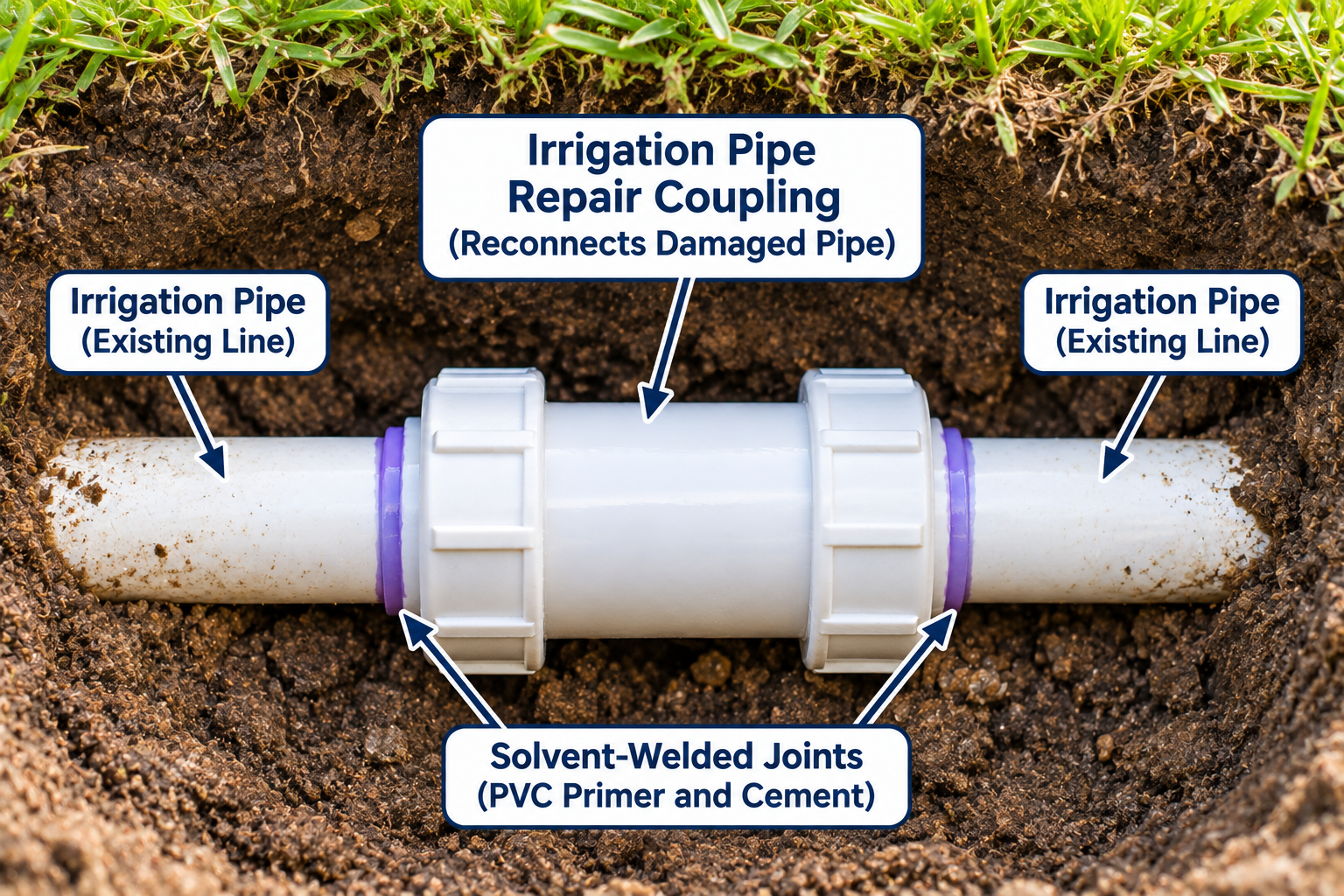
These specialized fittings are designed to reconnect compatible irrigation pipes and restore a watertight connection without necessarily replacing an entire irrigation line.
Although a repair coupling may seem like a simple plumbing component, improper installation can lead to recurring leaks, reduced water pressure, soil erosion, and additional damage to underground irrigation equipment.
Understanding the different types of repair couplings, how they are installed, and what precautions should be taken can help homeowners maintain dependable outdoor watering systems.
Brown Plumbing & Heating can help homeowners in Billings and Laurel evaluate outdoor water supply concerns and determine appropriate repair solutions for damaged irrigation piping.
Why Underground Irrigation Pipes Become Damaged
Underground irrigation pipes are exposed to several conditions that can affect their long-term performance.
One common cause of damage is accidental contact during landscaping work.
Digging with a shovel, installing fence posts, planting trees, or completing other outdoor projects can puncture or crack buried water lines.
Irrigation piping may also experience stress from soil movement.
Changes in soil moisture, settling, and nearby construction activities can place pressure on underground components.
Freezing temperatures create another concern.
If water remains trapped inside irrigation piping during Montana’s winter months, it may freeze and expand.
This expansion can damage pipes, fittings, and connected irrigation components.
Older installations may also experience deterioration caused by improper materials, poor connections, or previous repairs.
Identifying why a pipe failed is important before installing a replacement fitting.
A repair coupling may restore a damaged connection, but it cannot correct every underlying cause of pipe failure.
What Is an Irrigation Pipe Repair Coupling?
An irrigation pipe repair coupling is a fitting used to reconnect sections of damaged irrigation piping.
Its purpose is to restore a secure connection so water can flow through the repaired line without leaking.
Several types of couplings are available for different piping materials.
Some are designed for rigid PVC irrigation pipes.
Others are intended for polyethylene tubing or specialized irrigation systems.
Certain repair couplings allow limited adjustment during installation, which can be useful when the existing underground pipe cannot be moved easily.
Other fittings require the pipe ends to be positioned precisely.
The correct coupling depends on the pipe material, outside diameter, operating pressure, and repair conditions.
A fitting should never be selected solely because it looks similar to the original connection.
Proper compatibility is essential for creating a dependable repair.
Recognize the Signs of a Damaged Irrigation Pipe
Underground irrigation leaks are not always immediately visible.
Because the piping is buried, water may escape into the surrounding soil before homeowners notice a problem.
One common warning sign is an unusually wet area of lawn.
A section of grass may remain saturated even when nearby landscaping is relatively dry.
Homeowners may also notice puddles forming while the sprinkler system operates.
Another possible symptom is reduced water pressure.
If water escapes through a damaged underground pipe, sprinklers farther along the irrigation line may receive less water.
This can cause shorter spray distances or uneven coverage.
An unexpected increase in water usage may also indicate a leak.
However, these symptoms can have other explanations.
Poor drainage, damaged sprinkler heads, and malfunctioning valves can produce similar conditions.
A careful inspection helps determine whether the underground pipe actually requires repair.
Locate the Source of the Leak Before Digging
Before installing a repair coupling, homeowners should identify the approximate location of the damaged pipe.
This can help reduce unnecessary excavation.
Start by observing the irrigation system during normal operation.
Look for areas where water rises from the soil or where the lawn becomes unusually wet.
If the system has multiple zones, determine which zone is associated with the problem.
A leak affecting only one zone may be located within that section of the irrigation network.
A problem affecting several zones may involve a shared supply line.
However, underground water can travel through soil before reaching the surface.
The wettest visible area is not always directly above the damaged pipe.
Homeowners should avoid digging extensively without a reasonable understanding of the pipe’s location.
For difficult leaks, professional inspection may help identify the source and limit unnecessary landscape disruption.
Contact Montana 811 Before Excavation
Excavating around underground irrigation piping requires caution.
Residential properties may contain buried natural gas lines, electrical cables, communication lines, and other water supply connections.
Before digging, homeowners in Billings and Laurel should contact Montana 811 to request utility marking.
The process helps identify participating utility-owned infrastructure.
However, certain privately installed lines may require separate locating services.
These can include private irrigation systems, landscape lighting cables, and other owner-installed utilities.
Never assume that an area is safe to excavate simply because an irrigation pipe is already visible nearby.
Other infrastructure may cross the same location.
When digging around suspected piping, use appropriate precautions and avoid unnecessary force.
Careful excavation helps prevent a relatively small irrigation repair from becoming a larger plumbing or utility problem.
Identify the Existing Pipe Material
Before purchasing a repair coupling, determine what type of pipe is installed.
Many residential irrigation systems use rigid PVC piping or flexible polyethylene tubing.
However, the materials and specifications vary by installation.
Different pipe materials require different repair methods.
PVC systems often use fittings designed for solvent-welded connections.
Polyethylene systems may use compatible insert fittings, compression fittings, or other approved joining methods.
The pipe’s diameter is also important.
A coupling intended for one pipe size may not create a reliable seal on another.
Homeowners should identify the actual pipe specifications rather than relying on visual estimates.
Some piping includes printed markings that indicate the manufacturer, material, and size.
If the markings are not visible, measurements or professional assistance may be necessary.
Selecting the correct fitting helps prevent leaks and premature connection failure.
Understand the Different Types of Repair Couplings
Irrigation repair couplings are available in several designs.
Standard couplings connect two compatible pipe ends using the joining method specified for the piping system.
For rigid PVC installations, certain couplings require solvent cement and an appropriate installation procedure.
Telescoping repair couplings are designed to extend or adjust, allowing repairs when there is limited room to move the existing piping.
These fittings can be helpful in certain underground applications, but they must be rated for the intended pressure and installation conditions.
Compression repair couplings use mechanical sealing components to connect compatible pipes.
Other systems may use specialized fittings for polyethylene irrigation tubing.
Not every coupling is suitable for permanent underground installation.
Some products have specific restrictions involving pipe material, pressure, burial conditions, or accessibility.
Homeowners should carefully review the manufacturer’s specifications before selecting a repair method.
Choose a Coupling Rated for the Water Pressure
A repair coupling must withstand the pressure experienced by the irrigation system.
Normal operating pressure depends on the water supply, system design, valves, and connected equipment.
A fitting rated below the actual operating conditions may fail prematurely.
Before installation, verify that the coupling is appropriate for the intended pressure range.
Consider the maximum pressure the line may experience, not just the pressure observed while sprinklers are operating.
Some irrigation components experience higher static pressure when water is not flowing.
Pressure fluctuations can also occur when irrigation valves open or close.
Homeowners should avoid installing temporary or low-pressure fittings in a system that requires a permanent pressure-rated connection.
Using an appropriately rated coupling helps maintain reliability and reduces the chance of repeated leaks.
Expose Enough Pipe for a Proper Repair
A successful underground pipe repair requires adequate access.
A small excavation may reveal the damaged area but leave insufficient room to install the replacement fitting correctly.
Homeowners should expose enough piping to inspect the damage and work around the connection safely.
Avoid pulling, twisting, or bending rigid PVC pipes excessively.
These actions may place stress on nearby fittings.
If the pipe is surrounded by rocks or compacted soil, remove the material carefully.
The excavation should also provide room to keep dirt out of the pipe during the repair.
Homeowners should inspect the exposed section for additional cracks or deterioration.
A visible puncture may not be the only damaged area.
If several inches of piping have been stressed or fractured, replacing an appropriately sized section may be more reliable than covering a single crack.
Proper access makes it easier to prepare and install the coupling correctly.
Remove Damaged Pipe Sections Carefully
Before installing the repair coupling, the damaged portion of the pipe may need to be removed.
The amount of pipe removed depends on the repair method and fitting requirements.
The remaining pipe ends must be suitable for a secure connection.
Cracked, distorted, or deteriorated sections should not be left inside a fitting if they prevent proper sealing.
When cutting the pipe, use a tool appropriate for the material.
Aim for clean, properly aligned cuts.
Rough or angled pipe ends may interfere with certain fittings.
After cutting, remove loose debris and prepare the ends according to the manufacturer’s instructions.
Avoid allowing dirt or plastic fragments to enter the open line.
The goal is to create clean, undamaged pipe ends that can accept the selected coupling.
Prepare PVC Pipe Connections Correctly
Rigid PVC irrigation pipes commonly use solvent-welded fittings.
These connections require specific preparation and assembly procedures.
The pipe and fitting must be compatible.
The surfaces should be clean and properly prepared according to the solvent cement manufacturer’s instructions.
Where required, use the appropriate primer.
Follow the specified application and assembly procedures.
Homeowners should not assume that applying more cement creates a stronger connection.
Improper assembly can produce weak or leaking joints.
Environmental conditions may also affect the required handling and curing time.
A newly assembled connection should not be pressurized before the required curing conditions have been met.
Always follow the product manufacturer’s instructions.
A correctly prepared connection is essential for preventing underground leaks.
Use the Correct Method for Polyethylene Pipe
Flexible polyethylene irrigation piping requires different repair methods from rigid PVC.
Some polyethylene systems use insert fittings secured with compatible clamps.
Others use compression fittings or specialized connection systems.
The correct method depends on the pipe specifications and intended use.
Homeowners should verify that the coupling is designed for the exact pipe type and size.
A fitting that appears to fit may still be unsuitable.
Improperly secured polyethylene connections may separate when the line becomes pressurized.
Follow the manufacturer’s instructions for insertion depth, clamps, and assembly tools.
Avoid using fittings intended for unrelated tubing materials.
The completed connection should be properly supported and tested before burial.
Correct installation helps maintain a secure repair throughout the watering season.
Prevent Stress on the New Coupling
After the repair coupling is installed, the connected piping should remain properly aligned.
The fitting should not be used to force two severely misaligned pipe sections together.
Excessive bending or tension may weaken the repair.
This is especially important for rigid underground piping.
If the pipe has shifted because of soil movement or previous excavation, additional adjustments may be needed.
Homeowners should determine why the pipe ends no longer align.
A telescoping repair fitting may accommodate certain installation conditions, but it should not be considered a solution for every type of pipe movement.
The repaired section should be supported according to the piping and fitting requirements.
Proper alignment helps reduce mechanical stress and prevents unnecessary future leaks.
Keep Dirt and Debris Out of the Irrigation Line
Underground repairs expose the inside of irrigation piping to the surrounding environment.
Soil, gravel, and other debris may enter while the damaged section is removed.
If these particles travel through the system, they can clog sprinkler nozzles, filters, or irrigation valves.
Before beginning repairs, shut off the affected water supply and relieve pressure appropriately.
Keep open pipe ends protected from loose dirt.
Clean the exposed pipe according to the connection requirements.
If debris has entered the line, follow the manufacturer’s recommended flushing procedure.
Certain systems may require flushing before sensitive downstream components are returned to service.
Do not assume that debris will harmlessly pass through every sprinkler head.
A clean repair helps protect the rest of the irrigation system.
Allow the Repair to Set Before Testing
Some irrigation repair fittings can be tested after mechanical assembly, subject to their specifications.
Solvent-welded PVC fittings generally require appropriate curing before the system is pressurized.
The necessary curing period depends on the materials, temperature, pipe size, and other conditions.
Homeowners should not rush this step.
Restoring water pressure too early may compromise the connection.
Follow the manufacturer’s instructions for the specific products being used.
If the repair involves specialized fittings, verify whether additional assembly or inspection steps are required.
Once the connection is ready, the water supply can be restored using the appropriate startup procedure.
Allowing proper curing and following the manufacturer’s requirements helps reduce premature repair failures.
Test the Repair Before Backfilling
Testing is one of the most important steps in repairing underground irrigation piping.
After installing the coupling, restore the affected water supply according to the manufacturer’s instructions.
Inspect the new fitting and nearby pipe connections.
Look for dripping, spraying, or moisture appearing around the joint.
Operate the relevant irrigation zone under normal conditions.
Check whether the sprinkler heads receive appropriate water flow.
If water leaks from the coupling, shut off the supply and correct the problem.
Do not cover the connection with soil until the repair has been tested successfully.
Some installations may require additional pressure testing or inspection procedures.
The appropriate method depends on the system and applicable requirements.
Testing before burial helps prevent the need to excavate the same location again.
Backfill the Repair Area Properly
Once the repair has been tested, the excavation should be backfilled carefully.
The material surrounding the pipe can affect its long-term condition.
Large rocks, sharp debris, and uneven support may place concentrated stress on the repaired section.
Use suitable backfill materials according to the pipe and fitting manufacturer’s requirements.
The piping should receive appropriate support.
Avoid dropping heavy rocks directly onto the coupling.
Do not force soil against the pipe in a way that bends or displaces the connection.
Backfill should be placed and compacted as appropriate for the installation.
If the repaired area is beneath a lawn, restore the soil and landscaping after the piping is secure.
Homeowners should monitor the area for settling.
Proper backfilling helps protect the repair from unnecessary mechanical damage.
Watch for Recurring Leaks
A properly installed repair coupling should restore the damaged section to reliable operation within its rated conditions.
However, homeowners should continue monitoring the area.
If the soil becomes unusually wet again, the connection may require further inspection.
Recurring leaks can indicate several problems.
The original pipe may have additional cracks.
The repair fitting may be incompatible or improperly assembled.
Excessive water pressure or soil movement may also contribute.
Homeowners should avoid repeatedly replacing the same fitting without identifying why it continues to fail.
In some cases, a larger section of irrigation piping may need replacement.
Professional evaluation can help determine whether a localized repair is sufficient.
Addressing the underlying cause helps prevent ongoing water waste.
Consider the Effects of Water Pressure and Water Hammer
Underground irrigation connections experience changes in pressure when watering cycles begin and end.
Certain systems may produce pressure surges when valves close rapidly.
These surges can place additional stress on pipes and fittings.
A properly rated repair coupling should be selected for the expected operating conditions.
However, repeated pressure-related failures may indicate a broader irrigation problem.
Homeowners may notice loud banging sounds when irrigation valves operate.
Other symptoms can include recurring fitting leaks or unusual pipe movement.
If these conditions occur, the irrigation system should be evaluated.
Installing stronger fittings without addressing excessive pressure may not solve the underlying issue.
A plumber can help determine whether pressure regulation, valve operation, or another system condition requires attention.
Protect Irrigation Repairs From Montana Winters
Freezing temperatures are a major concern for underground irrigation systems in Billings and Laurel.
Even a properly installed repair coupling can be damaged if water freezes inside the connected piping.
Before winter, the irrigation system must be prepared according to its design.
Some installations are designed for gravity drainage.
Others require a properly performed compressed-air winterization procedure.
The correct method depends on the piping layout and connected components.
Homeowners should not assume that underground pipes are automatically protected from freezing.
Burial depth and retained water both affect freeze risk.
If a pipe repeatedly breaks near the same location after winter, the system’s winterization method may need evaluation.
A repair coupling restores a connection, but it does not eliminate the need for proper freeze protection.
Inspect Repaired Irrigation Lines During Spring Startup
Spring is an important time to inspect underground irrigation systems before regular watering begins.
Homeowners should restore the irrigation supply according to the manufacturer’s startup procedure.
Activate the irrigation zones individually.
Observe sprinkler performance and check for unusual wet areas.
Pay particular attention to locations where piping has been repaired previously.
If water pressure is lower than expected, investigate possible leaks or restrictions.
Check nearby sprinkler heads for normal operation.
Damage may also occur elsewhere in the system during winter.
A spring inspection helps identify problems before the irrigation system begins operating regularly.
Prompt repairs can help reduce unnecessary water loss and landscaping damage.
Know When a Pipe Should Be Replaced Instead of Repaired
A repair coupling may be appropriate for isolated damage to an otherwise sound irrigation line.
However, some situations require more extensive work.
Piping with multiple cracks, severe deterioration, or repeated failures may not be suitable for another localized repair.
A pipe that was installed using incompatible materials may also require correction.
If underground movement continues placing stress on a connection, replacing a larger section or modifying the installation may be necessary.
Homeowners should consider the condition of the surrounding piping before choosing a repair method.
A fitting can seal one damaged location, but it cannot restore the integrity of an entire deteriorated line.
A qualified plumber can help determine whether repair or replacement is the more appropriate long-term option.
Know When Professional Plumbing Assistance Is Necessary
Some irrigation pipe repairs can be completed using compatible fittings and proper installation procedures.
However, more complicated problems may require professional evaluation.
Professional assistance may be appropriate when underground leaks are difficult to locate or when the damaged piping is connected to the main irrigation supply.
A plumber can help assess water pressure, pipe condition, and the suitability of available repair methods.
If a repair involves household potable water piping or affects required backflow protection, additional requirements may apply.
Repeated underground leaks may also indicate a problem with system design or installation rather than an isolated damaged pipe.
Brown Plumbing & Heating can help homeowners in Billings and Laurel evaluate outdoor plumbing concerns and determine appropriate repair or replacement solutions.
Keep Your Irrigation System Reliable With Proper Pipe Repairs
An outdoor irrigation pipe repair coupling can provide a practical way to restore damaged underground piping without replacing an entire irrigation line.
However, reliable repairs depend on choosing the correct materials and following appropriate installation procedures.
Homeowners should first identify the source of the leak and determine why the pipe failed.
Selecting a compatible coupling, preparing clean pipe ends, and maintaining proper alignment are important steps.
The repaired connection should also be tested before backfilling.
Careful soil preparation and suitable backfill materials can help protect the fitting after installation.
For properties in Billings and Laurel, proper winterization remains essential because freezing water can damage even newly repaired irrigation piping.
Regular inspections during the growing season can help identify additional leaks before they cause significant water loss or landscaping damage.
With correct materials, careful installation, and ongoing maintenance, irrigation repair couplings can help restore reliable water delivery while protecting underground plumbing connections.
For homeowners experiencing underground irrigation leaks, damaged supply pipes, low water pressure, or recurring sprinkler system problems, Brown Plumbing & Heating can help assess the situation and recommend appropriate solutions.
Read Next: How to Prevent Plumbing Problems When Installing a New Outdoor Irrigation Blowout Connection