How to Prevent Plumbing Problems When Installing a New Outdoor Irrigation Manual Drain Valve
A properly maintained irrigation system helps homeowners keep their lawns, gardens, and landscaped areas healthy throughout the growing season. However, outdoor irrigation systems require special attention when temperatures begin to drop, especially in areas that experience freezing winters.
For homeowners in Billings and Laurel, Montana, installing an outdoor irrigation manual drain valve can provide a convenient way to release water from certain sections of an irrigation system. These valves are designed to help homeowners drain accessible piping during maintenance or seasonal winterization.
When properly installed, a manual drain valve can make irrigation maintenance easier and help reduce the amount of water left inside designated pipes and components.
However, incorrect installation can create plumbing problems, including leaking connections, trapped water, damaged fittings, and frozen irrigation pipes. Installing a drain valve in the wrong location may also prevent the system from draining effectively.
Understanding how irrigation manual drain valves work, where they should be installed, and how to maintain them can help homeowners protect their outdoor plumbing systems.
Brown Plumbing & Heating can help homeowners in Billings and Laurel evaluate outdoor water supply concerns and determine appropriate plumbing solutions for irrigation connections.
Why Outdoor Irrigation Systems Need Drainage
Outdoor irrigation systems use networks of underground pipes, valves, fittings, and sprinkler heads to distribute water throughout a property.
During the growing season, these components are regularly filled with water.
When an irrigation system is shut off, some water may remain inside the piping.
This is normal for many pressurized irrigation systems.
However, retained water can become a problem when temperatures fall below freezing.
As water freezes, it expands.
If the expansion creates enough pressure within a confined component, piping and fittings may crack or become damaged.
For homeowners in Billings and Laurel, winter temperatures make irrigation drainage an important consideration.
A properly designed drainage arrangement helps remove water from sections of the system that are intended to be drained.
Manual drain valves can provide designated access points for this process.
However, not every irrigation system can be fully winterized using manual drains alone.
The appropriate approach depends on the piping layout, equipment, and installation design.
Understanding How a Manual Irrigation Drain Valve Works
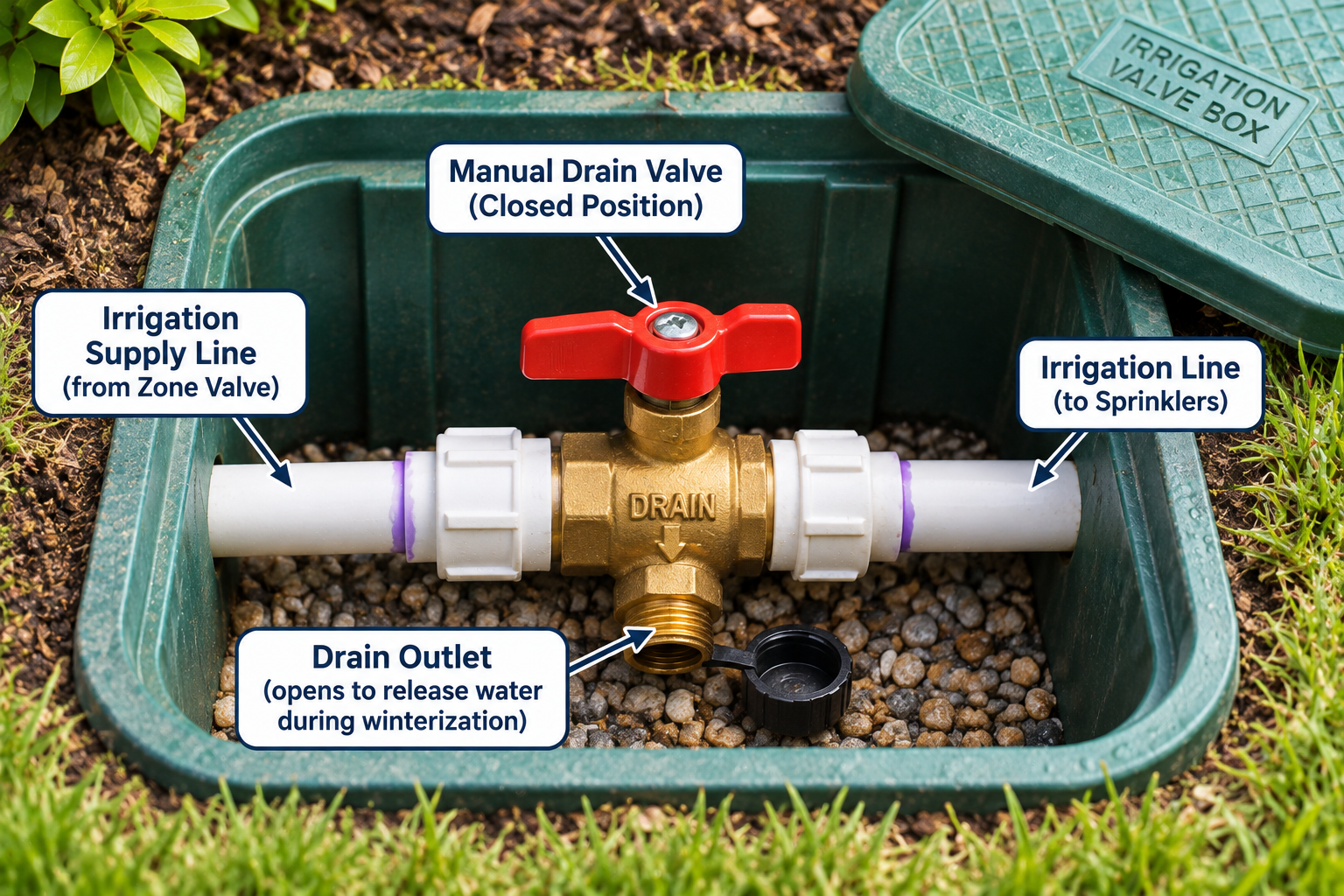
A manual irrigation drain valve is a plumbing component that allows water to be released from a designated section of irrigation piping.
Unlike an automatic drain valve, a manual valve requires someone to open it.
When the valve opens and the system is properly isolated and depressurized, water may flow out through the drainage connection.
The effectiveness of this process depends on the location of the valve and the arrangement of the piping.
Gravity is often an important factor.
Water naturally moves toward lower elevations when the piping has an open drainage path and air can enter appropriately.
A valve installed at a low point may allow certain sections of the system to drain.
However, piping that rises and falls across a property may contain areas where water remains trapped.
A manual drain valve does not automatically remove water from every pipe.
Homeowners should understand the drainage characteristics of their specific irrigation system before relying on a valve for winter preparation.
Understand the Difference Between Manual and Automatic Drain Valves
Manual and automatic irrigation drain valves serve related purposes, but they operate differently.
A manual valve must be opened when drainage is required.
This gives the homeowner control over when water is released.
Automatic drain valves are designed to open under particular pressure conditions, depending on the product.
Some automatic drainage components are intended to release water after irrigation pressure decreases.
However, these devices may not be appropriate for every irrigation system.
They also introduce considerations involving drainage location and potential contamination.
A manual drain valve may be suitable for systems where controlled seasonal drainage is preferred.
An automatic drain valve may be used in certain installations designed specifically for that method.
Homeowners should not assume that the two products are interchangeable.
The appropriate device depends on the irrigation system’s design, applicable plumbing requirements, and winterization strategy.
Choose the Correct Type of Manual Drain Valve
Manual drain valves are available in different materials, sizes, and configurations.
Some installations use approved ball valves or other suitable shutoff-style components as part of a dedicated drainage arrangement.
Other systems may use specialized drain fittings designed for irrigation applications.
The selected valve must be compatible with the piping materials and operating conditions.
Before purchasing equipment, verify the connection size and pressure rating.
The valve should also be suitable for outdoor installation and any expected exposure conditions.
Certain components may require protection from direct sunlight, freezing temperatures, or physical damage.
Homeowners should review the manufacturer’s specifications.
Avoid selecting a valve solely because it fits an existing pipe connection.
The complete installation must provide appropriate drainage without compromising the irrigation supply.
A properly selected valve helps reduce leaks and maintenance problems.
Identify the Correct Drainage Location
The location of a manual drain valve is one of the most important installation considerations.
In a gravity-drained irrigation system, the valve is commonly positioned at an appropriate low point.
This allows water from connected piping to move toward the discharge opening.
However, a property may contain multiple elevations.
A single low point may not allow every section of the irrigation system to empty.
For example, an underground supply line may travel downhill and then rise toward another section of the yard.
Water can remain trapped in the lower portion of that piping if the drainage arrangement does not provide a suitable outlet.
Homeowners should review the irrigation layout before choosing a valve location.
Consider the elevations of pipes, valves, and sprinkler connections.
Some systems may require multiple drainage points.
Others may be designed for a different winterization method.
A qualified professional can help determine whether the proposed location provides effective drainage.
Evaluate the Existing Irrigation Piping
Before installing a new drain valve, inspect the available irrigation piping.
Identify the main irrigation supply, zone valves, backflow prevention equipment, and existing drainage components.
Understanding how the system is arranged helps prevent installation mistakes.
Homeowners should look for signs of damaged piping, leaking fittings, and previous repairs.
An irrigation system that already experiences leaks should be evaluated before additional components are installed.
Adding a drain valve will not correct damaged underground connections.
The piping material must also be identified.
Different materials require different joining methods and fittings.
Homeowners should confirm that the new drain valve can be connected using approved materials.
If the existing piping is deteriorated or improperly supported, repairs may be necessary before installation.
Evaluating the water supply helps create a more reliable drainage arrangement.
Locate Underground Utilities Before Digging
Installing a manual drain valve may require excavation to expose underground irrigation piping.
Before digging, homeowners should identify existing utilities.
Residential properties may contain natural gas lines, electrical cables, communication lines, water supply piping, and other buried infrastructure.
In Montana, homeowners should contact Montana 811 before excavation to request utility marking.
Certain privately installed utilities may require separate locating services.
These can include privately owned irrigation piping, landscape lighting cables, and other underground connections.
Homeowners should not assume that an area is safe simply because the excavation is shallow.
Underground pipes and cables may be located closer to the surface than expected.
Careful excavation helps prevent accidental damage and unnecessary repairs.
Install the Valve Using Compatible Fittings
A manual drain valve must connect securely to the irrigation piping.
Depending on the materials, the installation may require threaded fittings, solvent-welded connections, compression fittings, or another approved method.
Homeowners should verify that all components are compatible.
Using incorrect fittings can create leaks or damage the piping.
Plastic threaded connections may crack if overtightened.
Some products require specific sealing materials, while others incorporate washers or other sealing components.
Follow the manufacturer’s installation instructions.
Avoid forcing a valve into a piping arrangement that does not align properly.
The connected pipes should be adequately supported.
A valve should not be subjected to unnecessary bending stress.
Correct installation helps maintain a secure connection during normal irrigation operation.
Provide a Suitable Drainage Discharge Location
An irrigation drain valve must release water into an appropriate location.
Allowing drainage water to collect against a home’s foundation can create moisture problems.
Repeated discharge may also contribute to soil erosion or muddy landscaping.
Before installation, consider where the water will travel when the valve is opened.
The discharge location should be suitable for the expected water volume.
Avoid directing water toward walkways where it may create slippery conditions.
In colder weather, discharged water can freeze on exposed surfaces.
This can create additional hazards.
Homeowners should also avoid connecting an irrigation drain directly to a sanitary drainage system unless the arrangement is specifically approved and properly designed.
The drainage outlet must not compromise backflow protection or create a contamination pathway.
A properly planned discharge location helps prevent drainage maintenance from causing new problems.
Keep the Drain Valve Accessible
Manual drain valves must remain accessible because homeowners need to operate them during maintenance and winterization.
An underground valve that becomes buried beneath soil or landscaping materials may be difficult to locate.
Many installations benefit from an appropriate access box.
The enclosure should provide enough space to operate the valve safely.
Homeowners should be able to reach the valve without damaging nearby piping.
Avoid placing the installation beneath permanent landscaping structures.
Consider whether shrubs, tree roots, or future improvements may obstruct access.
The valve location should also be documented.
Keeping the component accessible makes seasonal maintenance easier and reduces unnecessary excavation.
Understand the Importance of Proper Pipe Slope
Pipe slope can affect how effectively an irrigation system drains.
When piping is arranged with a suitable slope toward a drainage point, gravity can help move water out of the line.
However, underground irrigation piping does not always follow a continuous downward path.
Soil conditions, landscaping features, and existing utilities may require changes in elevation.
These changes can create low sections where water remains trapped.
Installing a manual drain valve does not automatically correct poor drainage geometry.
Homeowners should consider whether the system was originally designed for gravity drainage.
If the piping contains multiple low points, a single valve may be insufficient.
The appropriate solution may involve additional approved drainage points or a different winterization method.
Understanding the piping layout helps prevent incomplete drainage.
Protect the Potable Water Supply From Backflow
Backflow prevention is an important consideration when modifying outdoor irrigation plumbing.
Irrigation piping may come into contact with soil, fertilizers, pesticides, and other potentially contaminated substances.
Under certain conditions, water can move backward toward the household potable water supply if appropriate protection is not installed.
A manual drain valve is not a backflow prevention device.
Opening a drain connection can also introduce additional considerations related to contamination.
The drainage arrangement must not create an unsafe connection between the irrigation supply and surrounding water or soil.
Homeowners should avoid installing unapproved drainage devices on potable water connections.
The complete irrigation system must retain appropriate backflow protection based on its design and applicable requirements.
A qualified plumber can help determine whether the proposed drainage arrangement is suitable.
Protecting drinking-water quality remains essential whenever outdoor plumbing is modified.
Know the Difference Between Drain Valves and Flush Valves
Manual drain valves and irrigation flush valves can appear similar, but they are often used for different purposes.
A flush valve is generally intended to provide an outlet for removing sediment and debris while water moves through the irrigation line.
A manual drain valve is used to release retained water from designated piping when the system is isolated and prepared for drainage.
Some approved components may support more than one maintenance function.
However, homeowners should not assume that a flush valve provides complete winter drainage.
Similarly, opening a drain valve may not create enough water movement to effectively flush sediment from a long irrigation line.
The system must be designed for the intended operation.
Understanding the differences helps homeowners choose suitable equipment and maintenance procedures.
Avoid Trapping Water in Valves and Fittings
Even when an irrigation pipe drains successfully, water may remain inside certain components.
Zone valves, filters, regulators, flow sensors, and backflow prevention assemblies may contain internal chambers that retain water.
A manual drain valve located elsewhere in the system may not empty those components.
This is particularly important during winterization.
Water trapped inside a valve housing can freeze and expand.
The resulting pressure may crack the housing or damage internal parts.
Homeowners should review the manufacturer’s winterization instructions for every major irrigation component.
Some equipment requires individual drainage or removal.
Other components may require a specific system-wide winterization procedure.
Do not assume that opening one drain valve protects the entire irrigation system.
A comprehensive approach helps prevent freezing damage.
Test the Drain Valve Before Backfilling
Testing is essential before completing an underground drain valve installation.
After connecting the valve, restore the irrigation water supply using the appropriate procedure.
Keep the new valve closed during normal pressurization.
Inspect the valve body and connected fittings for leaks.
If the assembly leaks, shut off the affected supply and correct the connection.
Once the installation is confirmed watertight, test the drainage function according to the system design and manufacturer’s instructions.
Isolate the water supply and relieve pressure appropriately before opening the drain.
Observe whether water exits through the intended discharge location.
Confirm that the valve can be closed securely afterward.
Do not bury the assembly until any installation problems have been corrected.
Testing while the components remain accessible helps prevent unnecessary excavation later.
Recognize Signs of a Leaking Drain Valve
A manual drain valve should remain closed during normal irrigation operation unless the system is specifically designed otherwise.
If the valve does not seal correctly, water may escape through the discharge opening.
This can create persistent wet soil or unexplained water usage.
Other warning signs include visible dripping, difficulty operating the handle, and moisture around underground fittings.
However, water near a valve box does not always indicate a plumbing leak.
Rainfall, groundwater, and nearby irrigation runoff may also contribute.
Homeowners should observe when the moisture occurs.
If water appears while the irrigation system is pressurized and the drain should be closed, the valve may require inspection.
A damaged internal seal or contaminated seating surface may prevent proper closure.
Depending on the product, repair or replacement may be necessary.
Prompt attention can help reduce water waste and additional property damage.
Avoid Forcing a Stuck Valve
Manual drain valves may become difficult to operate if they are rarely used.
Dirt, corrosion, mineral deposits, or worn internal components can interfere with movement.
If a valve becomes stuck, homeowners should avoid applying excessive force.
Forcing the handle may damage the valve stem or connected fittings.
This can create a leak that is more difficult to repair.
Instead, follow the manufacturer’s maintenance instructions.
The water supply may need to be shut off and pressure relieved before servicing the valve.
Some valves can be repaired using approved replacement parts.
Others may require replacement.
If the valve is located underground and difficult to access, professional assistance may be appropriate.
Routine inspection can help identify operating problems before winter preparation becomes necessary.
Prepare Irrigation Systems for Montana Winters
Winterization is one of the primary reasons homeowners consider installing manual irrigation drain valves.
Billings and Laurel experience freezing temperatures that can damage water-filled outdoor plumbing.
Before winter, homeowners should follow the appropriate procedure for their specific irrigation system.
This may involve shutting off the irrigation supply and opening designated drains in a prescribed sequence.
However, gravity drainage is only effective when the system is designed to drain that way.
Piping with trapped low points may retain water.
Certain valves and equipment may also require additional preparation.
Some irrigation systems require compressed-air winterization instead of relying solely on gravity.
Compressed-air procedures should be performed according to manufacturer specifications and appropriate safety precautions.
Incorrect pressure or equipment use can damage irrigation components and create injury risks.
Homeowners should not assume that installing a manual drain valve eliminates the need for professional winterization.
The goal is to prepare every vulnerable section of the system appropriately.
Consider Freezing Conditions Around the Drain Valve
The drain valve itself can be damaged by freezing temperatures.
Even if the valve is installed underground, water may remain inside its housing.
The amount of protection provided by the surrounding soil depends on burial depth and local conditions.
An access box does not automatically prevent freezing.
Homeowners should verify that the valve and its installation are suitable for Montana’s winter conditions.
The valve’s location and internal design may affect how completely it drains.
If the valve is intended to remain open during the winter, follow the manufacturer’s instructions and the system’s approved winterization procedure.
Avoid leaving equipment in an operating position that creates an unintended water connection or contamination risk.
Proper seasonal preparation helps protect both the drain valve and the rest of the irrigation system.
Inspect the Drain Valve Before Spring Startup
Spring is an important time to inspect outdoor irrigation equipment before regular watering begins.
Homeowners should locate the manual drain valve and check its condition.
Look for cracked housings, damaged fittings, corrosion, and signs of movement.
Remove accumulated dirt or debris from the access area.
If the valve was left open as part of the approved winterization procedure, return it to the required operating position before restoring normal water pressure.
Follow the irrigation system’s startup instructions.
Inspect the valve and connected piping for leaks.
Operate the irrigation zones and confirm that water reaches the intended equipment.
If the drain valve leaks or fails to close properly, repair or replacement may be necessary.
Spring inspections can help identify winter damage before regular watering begins.
Maintain the Valve Throughout the Growing Season
Routine maintenance helps keep manual drain valves reliable.
Homeowners should inspect the accessible components periodically.
Check for leaks, damaged fittings, and accumulated debris.
Keep the access box clear so the valve can be reached when needed.
If the manufacturer recommends exercising the valve periodically, follow the specified procedure.
Avoid opening a drain valve unexpectedly while the irrigation system is operating under pressure.
The appropriate maintenance steps depend on the valve and system design.
Homeowners should also monitor the surrounding soil for signs of persistent moisture.
If the valve develops a leak, identify the source before replacing components.
Regular maintenance helps reduce the likelihood of problems during seasonal winterization.
Document the Drain Valve Location
Underground irrigation components can become difficult to locate over time.
Grass, mulch, and landscaping changes may conceal access boxes.
Homeowners should document the location of a newly installed manual drain valve.
Photographs taken before backfilling can provide useful reference information.
A simple property diagram can also identify the valve’s approximate position.
Include nearby permanent landmarks such as building corners or walkways.
Record the type of valve and any important operating instructions.
Keep this information with other home maintenance records.
Clear documentation can make future winterization and repairs easier.
However, these records should not replace proper utility-location procedures before future excavation.
Know When Professional Plumbing Assistance Is Necessary
Installing a manual irrigation drain valve may involve underground pipe modifications, pressure-rated fittings, backflow prevention considerations, and winterization planning.
Professional assistance may be appropriate when the system has multiple elevation changes or complicated drainage requirements.
A plumber can help determine whether a proposed drainage point is suitable for the existing water supply arrangement.
Professional evaluation may also be necessary when the installation involves potable water piping or existing underground leaks.
If an irrigation system has experienced repeated freeze damage, the cause may involve inadequate winterization rather than a single damaged component.
A broader inspection can help identify the appropriate solution.
Brown Plumbing & Heating can help homeowners in Billings and Laurel evaluate outdoor plumbing concerns and determine appropriate repair or installation options.
Protect Your Irrigation System With Proper Drainage Planning
An outdoor irrigation manual drain valve can provide a useful access point for releasing water from designated sections of an irrigation system.
When properly selected and installed, the valve can make seasonal maintenance more convenient and support an appropriate winterization strategy.
However, effective drainage requires careful planning.
Homeowners should evaluate the piping layout, identify suitable drainage locations, and use compatible valves and fittings.
Proper discharge management, accessible installation, and appropriate backflow protection are also important.
For properties in Billings and Laurel, Montana’s freezing winters make complete irrigation winterization especially important.
A manual drain valve should not be considered a guarantee that every pipe, fitting, or irrigation component will empty.
Routine inspections during the growing season and careful preparation before winter can help reduce leaks, freezing damage, and unnecessary repairs.
With proper installation and maintenance, manual drain valves can contribute to a more dependable outdoor irrigation system while helping protect underground plumbing connections.
For homeowners experiencing leaking irrigation pipes, damaged outdoor valves, frozen plumbing components, or other water supply concerns, Brown Plumbing & Heating can help evaluate the situation and recommend appropriate solutions.
Read Next: How to Prevent Plumbing Problems When Installing a New Outdoor Irrigation Valve Box