How to Prevent Plumbing Problems When Installing a New Outdoor Irrigation Quick-Coupling Valve
A reliable outdoor irrigation system can make watering lawns, gardens, and landscaped areas more convenient. While automatic sprinklers are useful for routine watering, homeowners sometimes need additional access to water for cleaning equipment, watering newly planted landscaping, or connecting portable irrigation accessories.
For homeowners in Billings and Laurel, Montana, installing an outdoor irrigation quick-coupling valve can provide a convenient water connection at selected locations throughout a property. These valves allow compatible hoses or watering equipment to connect to a pressurized irrigation supply without requiring a conventional outdoor faucet at every location.
However, installing a quick-coupling valve requires careful planning. Improper connections, inadequate pipe support, incorrect pressure ratings, and poor winterization can lead to underground leaks, damaged fittings, and unnecessary water waste.
Because these valves are often connected to buried irrigation piping, installation mistakes may be difficult to identify after the system is covered.
Understanding how irrigation quick-coupling valves work and what precautions are necessary can help homeowners protect their outdoor plumbing systems.
Brown Plumbing & Heating can help homeowners in Billings and Laurel evaluate outdoor water supply concerns and determine appropriate plumbing solutions for irrigation connections.
What Is an Outdoor Irrigation Quick-Coupling Valve?
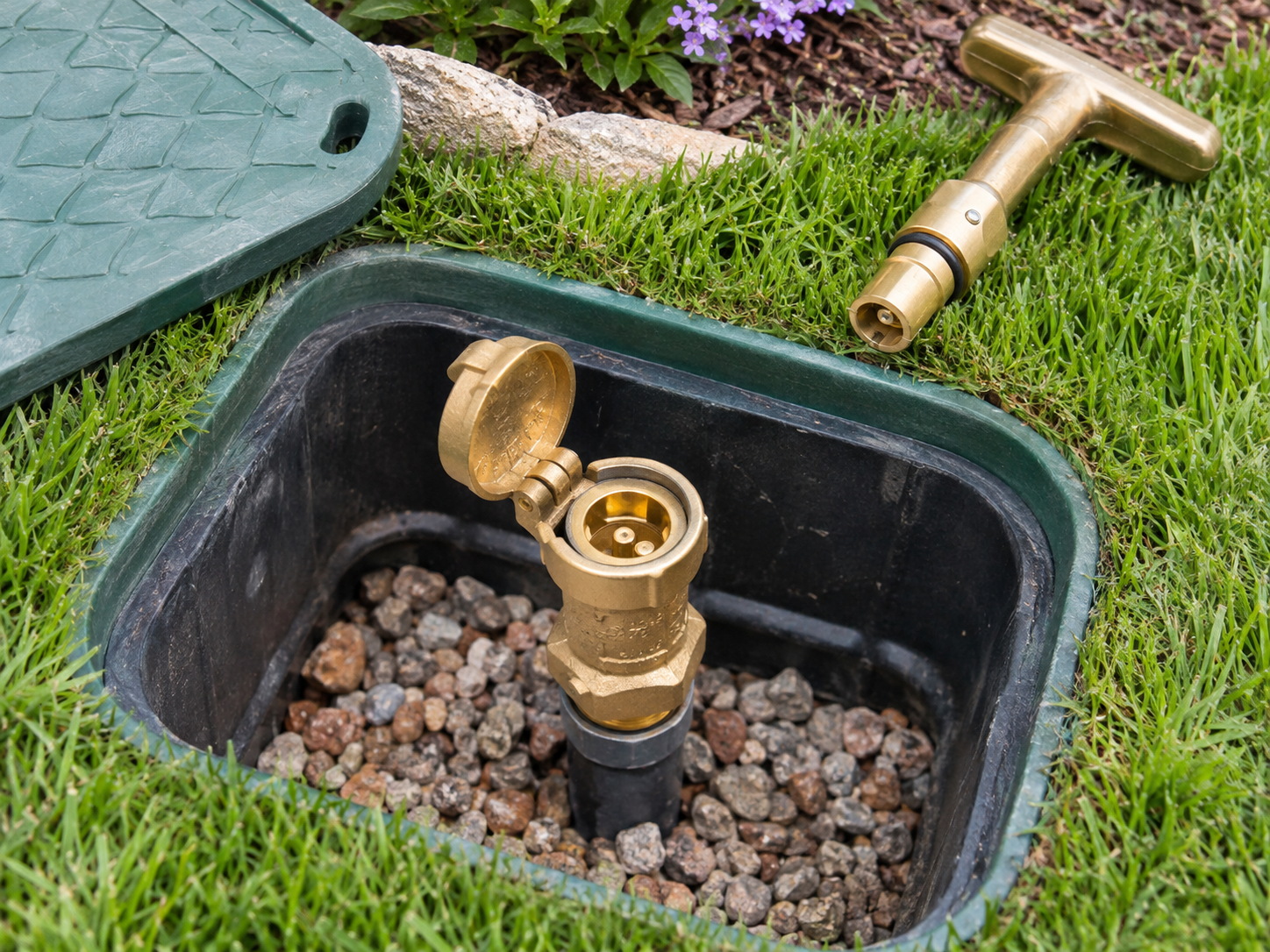
An outdoor irrigation quick-coupling valve is a specialized water outlet designed to provide convenient access to a pressurized irrigation supply.
Unlike a traditional outdoor hose faucet, many quick-coupling valves remain closed until a compatible connecting key is inserted and operated.
The key connects to the valve and allows water to flow into an attached hose or approved irrigation accessory.
When the key is properly removed, the valve closes.
Some designs include a protective cap or cover that helps keep dirt and debris out of the connection.
Quick-coupling valves are commonly associated with commercial landscaping, parks, golf courses, and larger irrigation installations.
However, they may also be useful for certain residential properties where convenient water access is needed away from the house.
The correct application depends on the water supply, equipment design, and applicable plumbing requirements.
Why Homeowners Install Quick-Coupling Valves
Properties with extensive landscaping may require water access in areas located far from the house.
Using long garden hoses can be inconvenient, especially when watering multiple garden beds or maintaining distant landscaping.
A properly positioned quick-coupling valve can provide an additional access point connected to a suitable irrigation supply.
This may reduce the distance homeowners need to move hoses or portable watering equipment.
Quick-coupling valves can also be useful for occasional maintenance tasks.
For example, a homeowner may need to water newly installed plants that are not yet connected to an automatic irrigation zone.
A compatible water outlet can make temporary watering more convenient.
However, the valve must be appropriate for the intended application.
Homeowners should not assume that every irrigation quick-coupling valve is approved for drinking-water use or direct connection to household potable plumbing.
Understanding the intended use before installation helps prevent compatibility and safety problems.
Choose the Correct Quick-Coupling Valve
Quick-coupling valves are available in different sizes, materials, and configurations.
The correct product depends on the available water pressure, required flow rate, piping arrangement, and intended equipment.
Some valves are made from brass or other durable materials.
Others incorporate specialized internal components designed for particular irrigation applications.
Before purchasing a valve, review the manufacturer’s specifications.
Verify the inlet connection size, operating pressure range, and compatibility with the intended quick-coupling key.
Not every key fits every valve.
A mismatched key may fail to open the valve or damage the connection.
Homeowners should also consider whether the product includes a protective cover.
A cover may help reduce dirt accumulation around the opening.
Choosing compatible components helps maintain reliable operation and reduce unnecessary repairs.
Evaluate the Existing Irrigation Water Supply
Before installing a quick-coupling valve, inspect the existing irrigation system.
Identify the proposed water supply connection and determine whether the system can provide adequate pressure and flow.
A quick-coupling valve connected to an undersized water line may not deliver enough water for the intended equipment.
The available flow depends on pipe diameter, pipe length, water pressure, and other connected components.
If the valve is installed on a supply shared with automatic irrigation zones, simultaneous water demand must also be considered.
Homeowners should avoid assuming that additional outlets increase the system’s total water capacity.
Adding a new water connection may require changes to the piping arrangement.
A qualified plumber can help evaluate whether the existing supply is suitable for the proposed installation.
Proper planning helps prevent low water flow and unexpected performance problems.
Select a Convenient Installation Location
The location of a quick-coupling valve affects accessibility and long-term maintenance.
Homeowners should place the valve where water access is useful without creating an obstacle.
For example, a valve near a large garden may provide convenient access for occasional watering.
However, installing the valve in the middle of a frequently used walkway could create maintenance and safety concerns.
Consider nearby lawn equipment, vehicles, landscaping features, and future construction plans.
Avoid locations where heavy equipment may repeatedly travel over the installation.
The valve should also remain accessible for inspection and repairs.
A protective valve box may be appropriate, depending on the product and installation design.
Homeowners should consider how hoses will be attached and where they will extend during normal use.
Careful placement can improve convenience while reducing accidental damage.
Locate Underground Utilities Before Excavation
Quick-coupling valves are often installed as part of an underground irrigation system.
Before excavating, homeowners should identify existing buried utilities.
Residential properties may contain electrical cables, natural gas lines, communication lines, water supply piping, and other underground infrastructure.
In Montana, homeowners should contact Montana 811 before digging to request utility marking.
Some privately installed lines may require separate locating services.
These can include private irrigation piping, landscape lighting cables, and other owner-installed systems.
Never assume that an area is safe for excavation simply because it is located within a lawn or garden.
Underground utilities can be present in unexpected locations.
Proper utility identification helps reduce safety hazards and prevent expensive damage.
Install the Valve at the Appropriate Depth
Quick-coupling valves must be installed at an appropriate depth relative to the finished landscape.
The required position depends on the valve model and installation instructions.
Some valves are designed to sit inside an accessible underground enclosure.
Others may be installed using specific mounting or support arrangements.
The valve must remain accessible enough for the connecting key to be inserted and operated.
Installing the valve too deeply may make it difficult to reach.
Positioning it too high may expose it to damage from landscaping equipment.
The surrounding soil and any protective enclosure should provide suitable support.
Homeowners should also consider whether the installation location is subject to settling or erosion.
A properly positioned valve is easier to operate and less likely to experience accidental damage.
Provide Proper Support for the Valve Assembly
A quick-coupling valve can experience mechanical stress when a key and hose are connected.
The weight of the attached equipment and movement of the hose may place pressure on the valve body.
Without proper support, these forces can transfer to underground pipe connections.
Over time, repeated movement may contribute to leaks or damaged fittings.
The valve should be installed using the support method recommended by the manufacturer.
Some installations may require a stabilizing arrangement that helps keep the valve upright.
The connected piping should not be forced into alignment.
Avoid using the water supply pipe itself as the only support when the product requires additional stabilization.
Homeowners should also avoid pulling heavily on hoses while they are connected.
Correct support helps protect underground fittings and maintain reliable operation.
Use Compatible Underground Plumbing Connections
The connection between the quick-coupling valve and irrigation supply piping must be watertight.
Depending on the materials, installation may involve threaded fittings, approved adapters, or other suitable connections.
Homeowners should confirm that every fitting is compatible with the valve and water supply pipe.
Avoid forcing mismatched threads together.
Overtightening certain fittings can damage the valve body or connected components.
The manufacturer may specify particular sealing materials or assembly procedures.
These instructions should be followed carefully.
Underground fittings must also be suitable for burial and the intended pressure conditions.
A fitting designed only for accessible indoor plumbing may not be appropriate for an outdoor buried irrigation application.
Proper materials and installation methods help reduce the risk of hidden leaks.
Understand the Importance of Water Pressure
Water pressure affects quick-coupling valve performance.
If pressure is too low, connected watering equipment may not operate as intended.
Low pressure can also make certain irrigation accessories ineffective.
Excessive pressure presents different concerns.
High pressure may place unnecessary stress on hoses, fittings, and the valve assembly.
A quick-coupling valve should be rated for the pressure available at the installation location.
Homeowners should also verify that attached hoses and equipment are compatible with the operating conditions.
The pressure may change when other irrigation zones begin operating.
For this reason, the complete system should be evaluated rather than considering only static water pressure.
If pressure problems already exist, adding another outlet may not correct them.
A plumber can help determine whether supply limitations or pressure regulation require attention.
Protect the Household Water Supply From Backflow
Backflow prevention is a particularly important consideration when installing an irrigation quick-coupling valve.
Outdoor hoses and irrigation equipment can come into contact with soil, fertilizers, pesticides, and other potentially contaminated substances.
Under certain conditions, water may move backward toward the household potable water supply.
A quick-coupling valve is not automatically an approved backflow prevention device.
Its primary purpose is to provide a controlled connection point for water delivery.
The complete installation may require appropriate backflow protection based on the water source, connected equipment, and applicable plumbing requirements.
Homeowners should not connect an irrigation quick-coupling valve directly to potable plumbing without verifying the required safeguards.
Specialized chemical application equipment may create additional protection requirements.
A qualified plumber can help determine an appropriate connection arrangement.
Protecting drinking water quality is essential when modifying outdoor plumbing systems.
Keep Dirt and Debris Out of the Valve
Outdoor quick-coupling valves are exposed to soil, grass clippings, dust, and other debris.
These materials can interfere with the connection mechanism.
If dirt enters the valve opening, it may prevent the connecting key from seating properly.
Debris can also affect internal sealing surfaces.
This may create leaks or make the valve difficult to operate.
Many quick-coupling valves include protective covers designed to reduce debris entering the connection.
These covers should remain in place when the valve is not being used.
Homeowners should inspect the opening before inserting the connecting key.
Remove visible dirt according to the manufacturer’s maintenance instructions.
Avoid forcing a key into a contaminated or obstructed connection.
Keeping the valve clean helps maintain dependable operation.
Use the Correct Quick-Coupling Key
The connecting key is an essential part of a quick-coupling valve system.
It is designed to engage the valve’s internal mechanism and allow water to flow.
Different valve manufacturers and models may use different keys.
Using an incompatible key can damage the valve or prevent it from opening.
Homeowners should purchase the key recommended for their specific valve.
Before operation, inspect the key for damage, debris, and worn sealing components.
Follow the manufacturer’s instructions for inserting and turning the key.
Avoid applying excessive force.
If the key does not engage properly, check compatibility and inspect the valve rather than forcing the connection.
A properly matched key helps reduce mechanical damage and leaking connections.
Prevent Hose Connections From Leaking
A quick-coupling key typically provides a connection point for a hose or another approved watering accessory.
This connection must be secure.
Damaged threads, worn washers, and incompatible fittings may allow water to escape.
Before attaching a hose, inspect the connection surfaces.
Replace damaged washers or other serviceable components according to the manufacturer’s recommendations.
Avoid overtightening hose fittings.
Excessive force can damage threads or sealing components.
The hose should also be positioned so that it does not place unnecessary sideways pressure on the key.
A tightly stretched hose may pull on the valve assembly and contribute to premature wear.
Proper connections help reduce water loss and protect the equipment.
Avoid Sudden Pressure Changes
Connecting and disconnecting watering equipment can create changes in water flow.
If water movement stops abruptly, a pressure surge may occur under certain conditions.
This is commonly associated with water hammer.
The risk depends on the flow rate, pressure, piping layout, and equipment design.
Homeowners should operate quick-coupling valves according to the manufacturer’s instructions.
Avoid forcing the connection or disconnecting equipment while it is under pressure if the manufacturer requires pressure to be relieved first.
If loud banging noises occur during operation, the system should be evaluated.
Repeated pressure surges may stress fittings and piping.
Proper operation helps reduce unnecessary wear on the irrigation system.
Test the Valve Before Backfilling
Testing is one of the most important steps in an underground plumbing installation.
After connecting the quick-coupling valve to the supply piping, restore water pressure according to the appropriate startup procedure.
Inspect the valve and all accessible fittings for leaks.
Insert the compatible connecting key according to the manufacturer’s instructions.
Confirm that water flows through the intended outlet.
Check the hose connection for moisture.
When the key is properly removed, verify that the valve closes as intended.
If the valve continues leaking, investigate the cause before completing the installation.
Do not bury leaking fittings.
Testing while the connections remain exposed makes it easier to correct installation problems.
Protect the Valve From Standing Water
An underground valve box can sometimes collect rainwater, irrigation runoff, or groundwater.
Although outdoor irrigation equipment is designed for exposure to moisture, excessive standing water can complicate maintenance.
Water may carry sediment into the valve enclosure.
This can increase dirt accumulation around the quick-coupling opening.
If the surrounding soil does not drain effectively, moisture may remain around the installation for extended periods.
Homeowners should consider drainage conditions when selecting a location.
The valve box should be installed according to its manufacturer’s instructions.
Avoid blocking intended drainage features.
Persistent standing water should be investigated to determine whether it results from surface drainage or a plumbing leak.
Maintaining an accessible and reasonably clean enclosure helps protect the valve.
Watch for Signs of Underground Water Leaks
Underground leaks may develop around a quick-coupling valve or its supply fittings.
Because the components are buried, water can escape into the soil without becoming immediately visible.
Possible warning signs include unusually wet ground, unexplained puddles, reduced water flow, and increased water usage.
However, moisture around a valve box may also result from rainfall or nearby irrigation.
Homeowners should observe whether the area remains wet when watering has been inactive.
If a leak is suspected, shut off the affected water supply when appropriate.
The valve and nearby fittings may need to be exposed for inspection.
A qualified plumber can help determine whether the leak involves the valve, supply piping, or another component.
Prompt attention can help reduce water waste and prevent additional soil erosion.
Prepare Quick-Coupling Valves for Montana Winters
Winterization is especially important for irrigation systems in Billings and Laurel.
Water trapped inside a quick-coupling valve can freeze when temperatures drop.
As water freezes, it expands and may damage the valve housing, internal mechanism, or connected fittings.
A valve installed underground is not automatically protected from freezing.
The risk depends on burial depth, remaining water, surrounding conditions, and the installation design.
Some quick-coupling valves are part of irrigation systems that require seasonal drainage or compressed-air winterization.
The appropriate procedure depends on the equipment.
Homeowners should follow the manufacturer’s instructions and the irrigation system’s winterization requirements.
Do not assume that removing the connecting key drains the entire valve or supply line.
Compressed-air procedures should be performed only with appropriate equipment and safety precautions.
Incorrect pressure or operating methods can damage components and create injury risks.
Proper winter preparation helps reduce the likelihood of cracked valves and underground leaks.
Inspect the Valve Before Spring Startup
Spring inspections can help identify damage that occurred during winter.
Before restoring regular irrigation operation, inspect the quick-coupling valve and its enclosure.
Look for cracks, corrosion, damaged covers, and accumulated debris.
Check that the connection opening is clean.
Inspect the compatible key and hose fittings.
Restore water pressure according to the system’s startup procedure.
Operate the valve and observe the connection for leaks.
If the key does not engage smoothly or the valve fails to close properly, avoid forcing the mechanism.
Further inspection or replacement may be necessary.
Spring maintenance helps identify problems before regular outdoor watering begins.
Maintain the Valve Throughout the Growing Season
Routine maintenance helps keep quick-coupling valves functioning properly.
Inspect the valve periodically for visible leaks and physical damage.
Keep the protective cover clean and properly positioned.
Remove accumulated soil and grass clippings from the surrounding enclosure.
Check the connecting key for wear.
If the valve becomes difficult to operate, follow the manufacturer’s troubleshooting instructions.
Avoid using excessive force or attempting unsupported repairs.
Homeowners should also monitor the condition of connected irrigation piping.
Unexpected changes in water pressure or flow may indicate a problem elsewhere in the system.
Maintaining the complete irrigation supply helps protect the quick-coupling installation.
Know When Professional Plumbing Assistance Is Appropriate
Installing a quick-coupling valve may involve modifying underground irrigation piping, evaluating water pressure, and selecting appropriate backflow protection.
These requirements can make the project more complicated than installing an ordinary hose accessory.
Professional assistance may be appropriate when a new connection is needed on a pressurized irrigation main.
A plumber can help assess compatible fittings, water supply capacity, and concerns involving underground leaks.
Professional evaluation may also be useful if an existing valve repeatedly leaks, freezes, or becomes difficult to operate.
If the installation involves household potable plumbing, appropriate backflow protection must be considered.
Brown Plumbing & Heating can help homeowners in Billings and Laurel evaluate outdoor water supply concerns and determine appropriate repair or installation options.
Keep Outdoor Water Connections Convenient and Reliable
An outdoor irrigation quick-coupling valve can provide convenient water access for homeowners with larger lawns, gardens, and landscaped properties.
When correctly installed, these valves can make it easier to connect compatible watering equipment at selected locations.
However, dependable operation requires careful planning.
Homeowners should choose a suitable valve, verify compatibility with the irrigation system, and install the equipment at an accessible location.
Proper underground connections, adequate pipe support, and appropriate water pressure are also important.
Backflow protection must be addressed whenever the system is connected to a potable water supply.
For properties in Billings and Laurel, Montana’s freezing temperatures make proper winterization essential.
Routine inspections and maintenance can help identify leaking fittings, damaged covers, and other problems before they become more serious.
With appropriate installation and ongoing care, a quick-coupling valve can provide useful outdoor water access while helping protect the property’s irrigation plumbing.
For homeowners experiencing outdoor supply leaks, damaged underground irrigation connections, or unusual water pressure, Brown Plumbing & Heating can help evaluate the situation and recommend appropriate solutions.
Read Next: How to Prevent Plumbing Problems When Installing a New Outdoor Sprinkler Check Valve