How to Prevent Plumbing Problems When Installing a New Outdoor Sprinkler Swing Joint
A properly functioning sprinkler system helps homeowners maintain healthy lawns, gardens, and landscaping while reducing the time spent watering by hand. However, reliable irrigation depends on more than sprinkler heads and automatic controllers. The connections between underground water supply lines and individual sprinklers also play an important role in preventing leaks and equipment damage.
For homeowners in Billings and Laurel, Montana, installing an outdoor sprinkler swing joint can help protect irrigation connections from certain types of movement and mechanical stress. These components are designed to provide flexibility or adjustability between the underground irrigation piping and the sprinkler head.
Without a suitable connection, shifting soil, lawn equipment, and accidental impacts can place stress on rigid irrigation fittings. Over time, these forces may cause cracked pipes, leaking connections, or damaged sprinkler heads.
Although sprinkler swing joints can improve installation flexibility, selecting the wrong components or installing them incorrectly can create additional plumbing problems.
Understanding how sprinkler swing joints work, where they should be used, and how to maintain them can help homeowners protect their irrigation systems and avoid unnecessary repairs.
Brown Plumbing & Heating can help homeowners in Billings and Laurel evaluate outdoor water supply concerns and determine appropriate plumbing solutions for irrigation connections.
What Is an Outdoor Sprinkler Swing Joint?
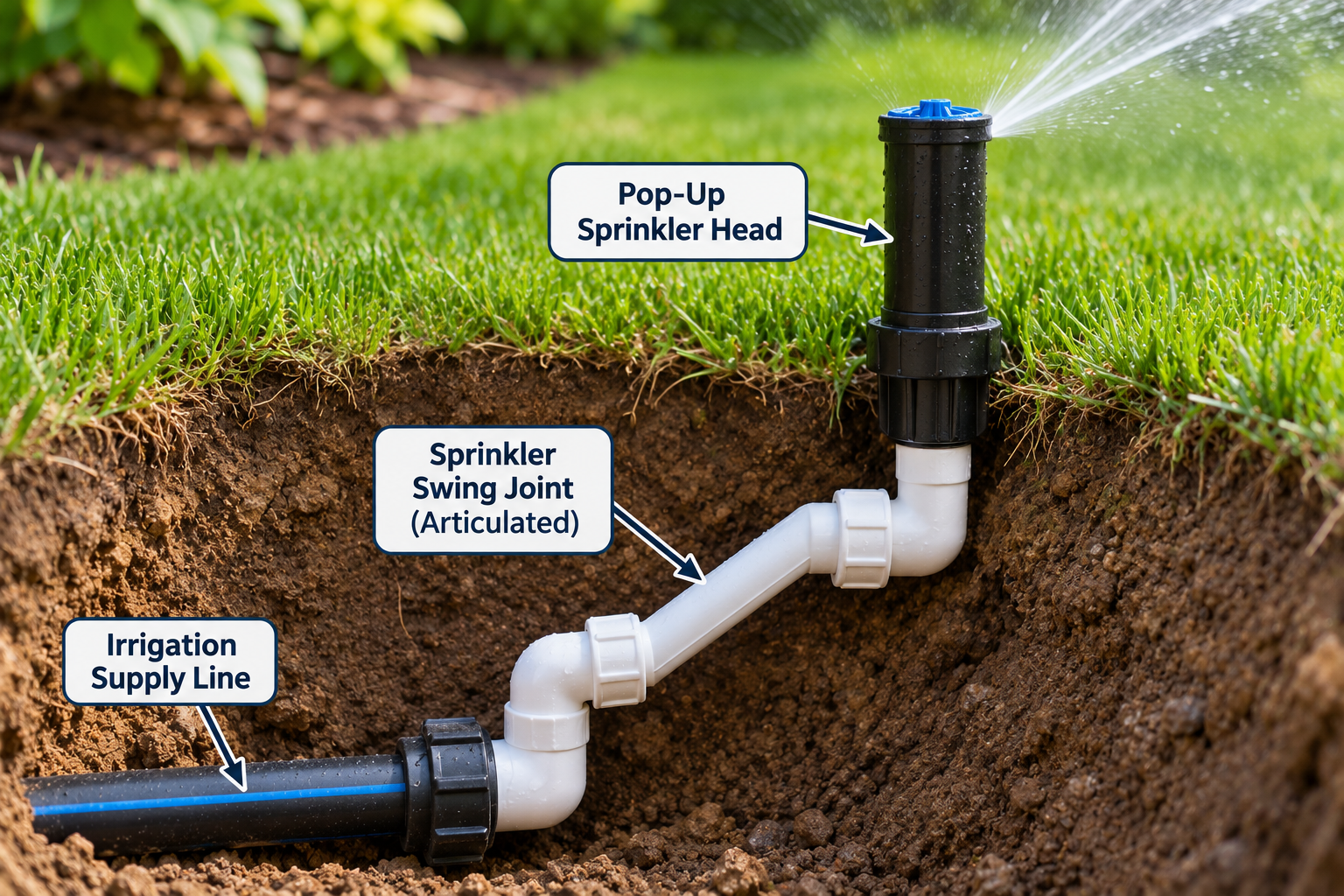
A sprinkler swing joint is a connection assembly installed between an underground irrigation supply line and a sprinkler head.
Its purpose is to allow the sprinkler to be positioned appropriately while reducing the amount of stress transferred directly to the underground piping.
Traditional swing joints often use multiple threaded elbows or specially designed rotating fittings.
These components allow the sprinkler to be adjusted vertically or horizontally without requiring the main irrigation pipe to be repositioned.
Some residential irrigation systems use flexible swing-pipe assemblies that provide similar installation flexibility.
However, rigid articulated swing joints and flexible swing-pipe connections are not identical products.
Each has its own pressure ratings, materials, installation methods, and intended applications.
The correct connection depends on the sprinkler type, pipe arrangement, and expected operating conditions.
Homeowners should choose a product designed specifically for the irrigation system rather than attempting to create a flexible connection using unsuitable plumbing materials.
Why Sprinkler Connections Experience Stress
Underground irrigation pipes may experience movement because of soil settling, seasonal ground changes, and landscaping activities.
Even small movements can affect rigid connections.
For example, a sprinkler head installed beside a driveway may occasionally experience pressure from nearby vehicles or maintenance equipment.
If the sprinkler connects directly to a rigid underground pipe, an impact can transfer force to the pipe fitting.
The result may be a cracked elbow, damaged threaded connection, or broken sprinkler body.
Soil movement can also cause problems.
When the ground settles unevenly, a rigid connection may experience bending stress.
A properly selected swing joint can accommodate some positioning changes and reduce the likelihood of certain types of damage.
However, swing joints are not designed to prevent every possible plumbing failure.
Significant vehicle loads, improper burial, or severe soil movement can still damage irrigation components.
Proper placement and installation remain essential.
Choose the Correct Swing Joint for Your Sprinkler
Before installing a swing joint, determine which type is compatible with the existing sprinkler system.
Different sprinkler heads have different connection sizes and operating requirements.
A small residential pop-up sprinkler may use a different connection arrangement than a larger rotor sprinkler.
The swing joint must match the sprinkler’s inlet connection and the underground irrigation piping.
Homeowners should verify the thread size, material compatibility, and pressure rating.
Some swing joints are designed for higher-flow irrigation applications, while others are intended for smaller residential systems.
The manufacturer may also specify how much movement or adjustment the assembly can accommodate.
Selecting a compatible product helps prevent connection problems and unnecessary modifications.
Avoid choosing a swing joint solely because it appears to fit the sprinkler head.
The complete assembly must be suitable for the water supply, installation environment, and expected mechanical loads.
Understand the Difference Between Swing Joints and Flexible Swing Pipe
Homeowners may encounter several products marketed as flexible sprinkler connections.
A traditional articulated swing joint uses rigid sections connected by specially designed fittings that permit positioning adjustments.
Flexible swing pipe uses tubing rated for irrigation applications, usually connected through compatible fittings.
Both arrangements may help position sprinklers and reduce certain mechanical stresses.
However, their installation requirements differ.
Flexible swing pipe must be compatible with its fittings and suitable for burial and pressurized water service.
The tubing should not be bent beyond the manufacturer’s recommended limits.
Similarly, articulated swing joints must be assembled according to the manufacturer’s instructions.
Some components are specifically designed to rotate or adjust, while ordinary threaded fittings may not provide the same movement.
Homeowners should not assume that any combination of elbows creates an appropriate swing joint.
Using purpose-designed components helps maintain reliable connections.
Evaluate the Existing Underground Irrigation Piping
Before installing a new swing joint, inspect the existing supply line and sprinkler connection.
Look for damaged fittings, cracked piping, and signs of leakage.
If the previous sprinkler was struck by lawn equipment, the underground connection may also have been damaged.
Replacing only the swing joint without repairing the supply pipe may leave the underlying problem unresolved.
Homeowners should also examine the pipe alignment.
A sprinkler connection that has shifted significantly may indicate soil movement or inadequate support.
The new assembly should be installed without forcing the piping into an unsuitable position.
If the underground pipe is damaged, it should be repaired using compatible materials and approved connection methods.
A sound connection to the existing supply is essential for preventing future leaks.
Choose the Right Installation Depth
Sprinkler swing joints are typically installed below ground, connecting the irrigation supply line to the sprinkler head.
The appropriate depth depends on the sprinkler, piping layout, and manufacturer’s instructions.
The assembly should provide enough clearance for proper positioning without creating unnecessary stress.
A connection installed too close to the surface may be exposed to damage from landscaping equipment or soil disturbance.
However, burying the assembly excessively deep can make future repairs more difficult.
The sprinkler itself must also be positioned at the correct height relative to the finished ground.
A properly designed swing joint can provide adjustment without requiring the main irrigation line to be moved.
Homeowners should consider the overall installation rather than focusing on the swing joint alone.
Correct depth and positioning help protect the sprinkler and its underground connection.
Locate Buried Utilities Before Excavation
Installing a sprinkler swing joint often requires excavation around an existing sprinkler head.
Before digging, homeowners should identify underground utilities.
Residential properties may contain buried electrical cables, gas lines, communication lines, irrigation piping, and other infrastructure.
In Montana, homeowners should contact Montana 811 before excavation to request utility marking.
Privately installed utility lines may require additional locating services.
These can include certain irrigation pipes, landscape lighting cables, and other owner-installed connections.
Even shallow excavation can damage buried infrastructure.
Homeowners should avoid assuming that digging near an existing sprinkler is automatically safe.
Proper utility identification helps reduce the risk of accidents and unexpected repair expenses.
Use Compatible Threaded Connections
Many sprinkler swing joints use threaded connections to attach to sprinkler heads and irrigation supply fittings.
Thread compatibility is important.
Using mismatched threads can damage fittings or prevent a watertight connection.
Before assembly, inspect the components for damaged threads, cracks, and debris.
Follow the manufacturer’s instructions regarding sealing materials.
Some threaded irrigation connections require particular sealants, while others are designed to seal using specific fittings or integrated components.
Avoid applying excessive thread sealant.
Overtightening plastic fittings can also cause cracking.
A connection that feels secure is not necessarily installed correctly if excessive force was required.
The assembly should fit together smoothly and remain properly aligned.
Correct connection methods help prevent underground leaks.
Avoid Excessive Bending and Mechanical Stress
A sprinkler swing joint is designed to provide a degree of positioning flexibility.
However, that flexibility has limits.
Forcing the assembly into an extreme position may place unnecessary stress on its fittings.
Flexible swing pipe can also become damaged if it is sharply bent, kinked, or twisted beyond the manufacturer’s limits.
Before completing the installation, check that the sprinkler and supply piping are aligned appropriately.
The connection should accommodate normal positioning without being stretched or compressed excessively.
Avoid using the swing joint to compensate for a severely misaligned or damaged main water line.
The underlying piping problem should be corrected first.
A properly installed assembly should support the sprinkler while allowing the adjustment intended by its design.
Maintaining suitable alignment helps reduce premature fitting failures.
Position the Sprinkler Head Correctly
One of the benefits of a swing joint is the ability to position a sprinkler head without directly moving the main irrigation pipe.
This can be useful when replacing a sprinkler or adjusting its height.
A pop-up sprinkler should be installed according to the manufacturer’s specifications relative to the surrounding lawn.
If the sprinkler is positioned too high, lawnmowers may strike it.
If it is installed too low, grass and soil may obstruct the spray pattern.
The swing joint should allow the sprinkler to remain properly positioned without creating stress at the connection.
Homeowners should also verify that the sprinkler remains upright.
A tilted sprinkler may distribute water unevenly and experience unnecessary mechanical loading.
Correct positioning helps protect the sprinkler and improve watering performance.
Protect the Connection From Soil and Debris
During excavation and installation, loose soil can enter open irrigation pipes.
This debris may eventually reach sprinkler heads, valves, or other components.
Even small particles can interfere with nozzles and internal sprinkler mechanisms.
Before disconnecting the existing assembly, shut off the affected irrigation supply as appropriate.
Keep open pipe connections protected from dirt.
If debris enters the piping, follow the irrigation manufacturer’s recommended flushing procedure.
Inspect the new swing joint before installation.
Avoid assembling fittings that contain sand, gravel, or other foreign materials.
Debris trapped in threaded connections may interfere with sealing.
Maintaining clean components helps prevent leaks and future irrigation problems.
Check the Irrigation System’s Water Pressure
Water pressure affects the entire sprinkler system, including underground fittings.
Excessive pressure may place unnecessary stress on connections.
In some systems, high pressure can also cause sprinklers to mist excessively or operate outside their intended range.
Insufficient pressure creates different problems.
Sprinkler heads may fail to rise fully or provide adequate coverage.
Before installing new components, verify that they are rated for the system’s operating conditions.
The swing joint should have an appropriate pressure rating.
If the irrigation system experiences repeated leaks or unusual pressure fluctuations, those conditions should be investigated.
A swing joint is not a pressure regulator.
It cannot correct excessive water pressure or compensate for an undersized supply line.
A qualified plumber can help determine whether pressure-related problems are affecting the installation.
Prevent Leaks at Underground Fittings
Underground irrigation leaks can be difficult to detect.
Water may escape into the surrounding soil without immediately becoming visible.
A damaged swing joint fitting may create unusually wet grass, reduced sprinkler performance, or unexplained water usage.
Proper installation helps reduce these risks.
Every connection should be assembled according to the manufacturer’s instructions.
After installation, the system should be tested before the excavation is filled.
Inspect the swing joint and its connections while water is flowing.
Look for dripping, spraying, or water collecting around the fittings.
If a connection leaks, shut off the affected supply and correct the issue.
Do not bury a leaking connection.
Testing while the assembly remains exposed can prevent unnecessary excavation later.
Use Proper Backfilling Methods
After confirming that the sprinkler connection is secure, the excavation must be backfilled.
The surrounding soil should support the sprinkler without placing excessive pressure on the swing joint.
Avoid dropping large rocks or construction debris directly against the fittings.
Use suitable backfill materials according to the piping and product requirements.
The soil should be placed in a way that supports the installation and reduces unnecessary movement.
However, homeowners should not force the sprinkler into position by packing soil tightly against a misaligned assembly.
The connection should already be properly positioned before backfilling begins.
After the soil settles, inspect the sprinkler height.
Additional adjustment may be necessary if the sprinkler sinks or shifts.
Proper backfilling helps maintain long-term stability.
Consider Lawn Equipment and Vehicle Traffic
Sprinkler heads located near driveways, sidewalks, and frequently maintained lawn areas may experience greater mechanical stress.
A swing joint can help reduce some of the force transferred to underground piping.
However, it does not make a sprinkler suitable for regular vehicle traffic.
Homeowners should avoid placing sprinkler heads where tires or heavy equipment repeatedly pass over them.
If a sprinkler must be located near a driveway, consider its position carefully.
The selected sprinkler and connection assembly should be appropriate for the expected conditions.
Regular mowing and trimming should also be considered.
A sprinkler that protrudes above the finished lawn may be damaged regardless of its underground connection.
Correct placement and routine inspection help reduce mechanical damage.
Recognize Signs of a Damaged Swing Joint
Sprinkler swing joints may become damaged because of impacts, soil movement, freezing, or deteriorating fittings.
One warning sign is persistent moisture around a sprinkler head.
Another is a sprinkler that becomes unusually loose or changes position.
Reduced water pressure may also indicate a leaking underground connection.
However, these symptoms can have other causes.
A damaged sprinkler body, clogged nozzle, or malfunctioning valve may create similar conditions.
Homeowners should investigate the problem before replacing components.
If the swing joint is suspected of leaking, the surrounding area may need to be excavated for inspection.
A damaged fitting should be repaired or replaced using compatible components.
Prompt attention can help reduce water waste and prevent additional soil erosion.
Understand How Swing Joints Affect Sprinkler Repairs
A properly installed swing joint can make certain sprinkler adjustments easier.
For example, when a sprinkler head must be replaced with a model of a different height, an adjustable connection may help accommodate the change.
This can reduce the need to relocate the main irrigation piping.
However, homeowners should verify that the replacement sprinkler is compatible with the existing connection.
Different sprinkler models may use different thread sizes and inlet configurations.
The new sprinkler should also match the irrigation zone’s pressure and flow requirements.
Avoid forcing the swing joint into an unsuitable position simply to accommodate an incompatible sprinkler.
If significant modifications are necessary, the connection assembly may need to be replaced.
Proper planning can help make future sprinkler maintenance more convenient.
Protect the System During Montana Winters
Freezing temperatures are a major concern for outdoor irrigation systems in Billings and Laurel.
Water trapped inside underground piping and sprinkler connections can freeze and expand.
This expansion may crack fittings, damage sprinkler bodies, or cause leaks when warmer weather returns.
A swing joint does not automatically protect an irrigation system from freezing.
The entire system must be winterized according to its design.
Some irrigation systems require draining, while others use a properly performed compressed-air winterization procedure.
The appropriate method depends on the installed piping, valves, sprinklers, and other components.
Compressed-air procedures must follow the manufacturer’s instructions and appropriate safety precautions.
Improper pressure or equipment use can damage irrigation components and create injury risks.
Homeowners should not assume that a flexible connection can withstand freezing water without damage.
Proper winterization helps protect both the swing joints and the larger irrigation system.
Inspect Sprinkler Connections During Spring Startup
Spring is an important time to inspect outdoor sprinkler systems.
Before regular watering begins, check visible sprinkler heads for damage.
Look for tilted sprinklers, cracked housings, and loose connections.
Restore water to the system using the appropriate startup procedure.
Activate each irrigation zone separately.
Observe the sprinklers while they operate.
If water appears to bubble up around a sprinkler base, the underground connection may require inspection.
However, moisture near a sprinkler can also result from normal spray or surface drainage.
Homeowners should look for persistent or unusual water movement.
If a leak is suspected, shut off the affected supply before investigating.
Spring inspections can help identify winter damage before the system begins regular operation.
Maintain Sprinkler Connections Throughout the Growing Season
Although swing joints are usually buried, their condition can affect sprinkler performance throughout the season.
Homeowners should periodically inspect sprinkler heads for movement, tilting, and unusual moisture.
Check whether the sprinkler retracts properly after irrigation.
A sprinkler that repeatedly shifts position may have an unstable underground connection.
Avoid using sprinkler heads as supports when moving hoses or landscaping equipment.
If a sprinkler is struck by a lawnmower, inspect it for damage.
Even when the visible sprinkler appears intact, the underground connection may have experienced stress.
Monitor water usage and irrigation pressure for unusual changes.
Routine inspections can help identify small problems before they require more extensive repairs.
Know When Professional Plumbing Assistance Is Appropriate
Replacing an existing sprinkler connection with compatible components may be manageable for some homeowners.
However, certain installations involve damaged underground piping, unusual pressure conditions, or extensive irrigation modifications.
Professional assistance may be appropriate when the existing water supply line is cracked or difficult to access.
A plumber can help evaluate leaking connections and determine whether the problem involves the swing joint, sprinkler head, or underground supply piping.
If several sprinkler connections repeatedly fail, the irrigation system may require a broader inspection.
Persistent problems can indicate excessive pressure, inadequate pipe support, or other installation conditions.
Brown Plumbing & Heating can help homeowners in Billings and Laurel evaluate outdoor plumbing concerns and determine appropriate repair or installation options.
Keep Your Outdoor Sprinkler Connections Reliable
An outdoor sprinkler swing joint can help provide a more adjustable connection between a sprinkler head and its underground water supply line.
When properly selected and installed, it can reduce certain types of mechanical stress and make sprinkler positioning easier.
However, reliable performance depends on using compatible components and following appropriate installation procedures.
Homeowners should inspect existing piping, select suitable fittings, avoid excessive bending, and position sprinkler heads correctly.
Testing connections before backfilling is also important for preventing hidden underground leaks.
In Billings and Laurel, Montana’s cold winter temperatures make proper irrigation winterization essential.
Routine inspections throughout the growing season can help identify damaged fittings, shifting sprinkler heads, and unexpected water loss.
With careful installation and maintenance, sprinkler swing joints can contribute to a more dependable irrigation system while helping protect underground plumbing connections.
For homeowners experiencing leaking sprinkler connections, damaged irrigation pipes, low water pressure, or other outdoor plumbing concerns, Brown Plumbing & Heating can help evaluate the situation and recommend appropriate solutions.
Read Next: How to Prevent Plumbing Problems When Installing a New Outdoor Pop-Up Sprinkler Head