How to Prevent Plumbing Problems When Installing a New Outdoor Irrigation Blowout Connection
Preparing an outdoor irrigation system for freezing temperatures is an important part of maintaining residential plumbing in Montana. When water remains trapped inside sprinkler lines, valves, and other irrigation components during winter, freezing temperatures can cause damage that may not become noticeable until spring.
For homeowners in Billings and Laurel, Montana, installing an outdoor irrigation blowout connection can provide a designated access point for professional sprinkler winterization. These connections are designed to allow appropriate equipment to be connected to an irrigation system so that remaining water can be removed using a controlled compressed-air procedure.
Although a blowout connection can make winterization more convenient, improper installation or operation can cause serious problems. Excessive air pressure, incompatible fittings, incorrect placement, and inadequate system preparation can damage sprinkler heads, underground piping, irrigation valves, and other components.
Understanding how irrigation blowout connections work and what installation considerations matter most can help homeowners protect their outdoor plumbing systems and reduce the risk of expensive repairs.
Brown Plumbing & Heating can help homeowners in Billings and Laurel evaluate outdoor water supply concerns and determine appropriate plumbing solutions for irrigation systems.
Why Irrigation Systems Need Winterization
Residential irrigation systems use underground pipes to deliver water to sprinkler heads, drip irrigation equipment, and other outdoor watering components.
During the growing season, these pipes regularly contain water.
When irrigation is shut off, some water may remain inside the system.
This water can become a problem when temperatures fall below freezing.
As water freezes, it expands. When expansion occurs inside confined plumbing components, it can crack pipes, damage fittings, and cause irrigation valves to fail.
These problems may not become obvious immediately.
A damaged pipe may remain frozen or inactive throughout winter and begin leaking when the irrigation system is reactivated in spring.
Montana’s cold weather makes appropriate irrigation winterization particularly important.
Different irrigation systems require different preparation procedures.
Some are designed for gravity drainage, while others may require a professionally performed compressed-air blowout.
A designated blowout connection can make the latter process more accessible when it is appropriate for the system.
Understanding What an Irrigation Blowout Connection Does
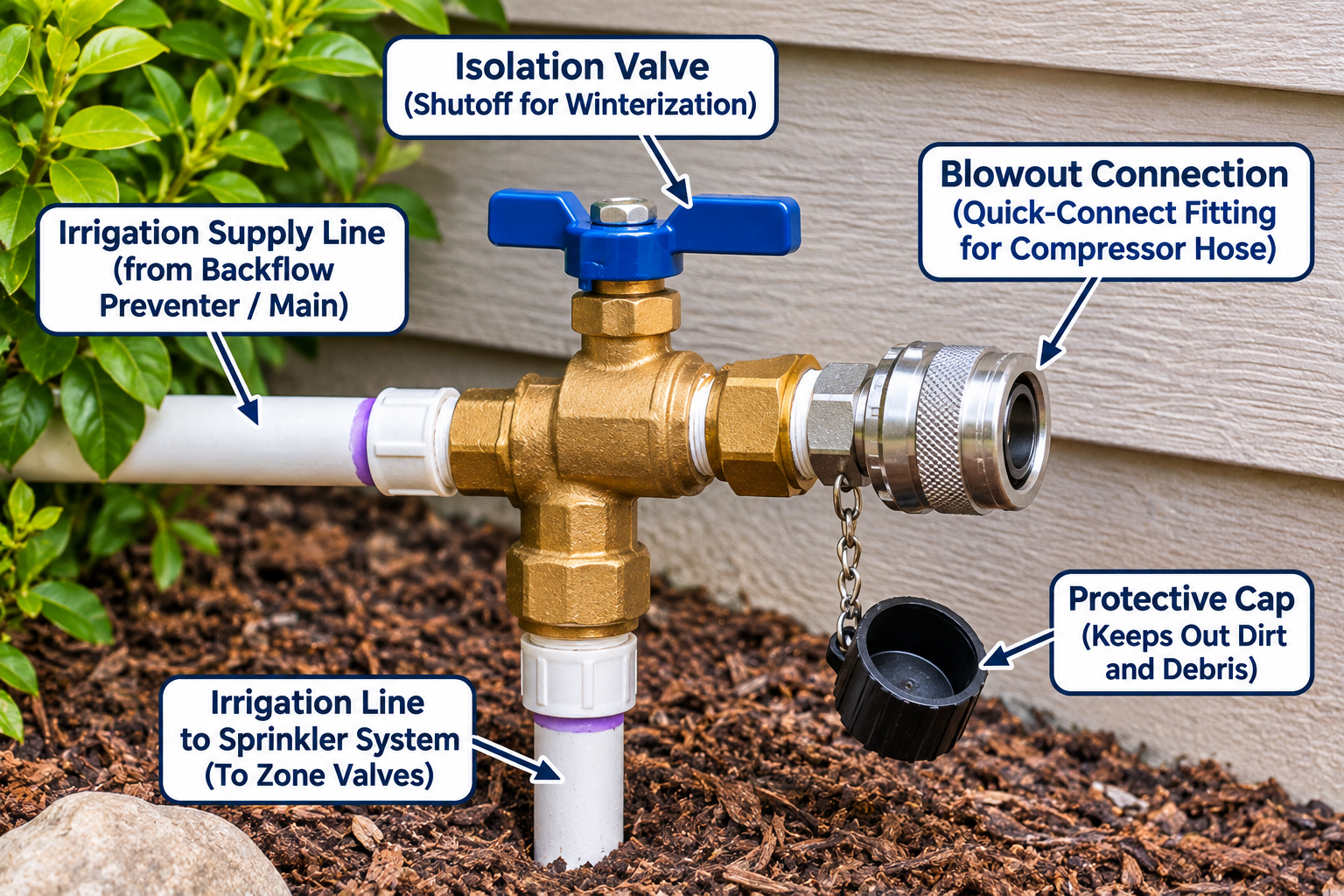
An outdoor irrigation blowout connection is a designated fitting or connection assembly that allows suitable winterization equipment to access the irrigation piping.
During an approved compressed-air winterization procedure, controlled air flow is used to move water out of designated irrigation lines.
Water is typically discharged through sprinkler heads or other appropriate outlets as individual irrigation zones are processed.
However, the procedure must be performed according to the irrigation system’s design and the equipment manufacturers’ requirements.
A blowout connection does not automatically remove water from the entire system.
It provides an access point for a winterization process.
The effectiveness of that process depends on the piping layout, connected components, air delivery characteristics, and correct operating procedures.
Homeowners should also understand that introducing compressed air into plumbing creates hazards if the equipment is used incorrectly.
A properly installed connection should support safe professional servicing rather than encourage uncontrolled pressurization.
Choose a Connection Designed for Irrigation Winterization
Not every air hose fitting or plumbing adapter is suitable for irrigation winterization.
An appropriate blowout connection must be compatible with the piping material, connection arrangement, and expected operating conditions.
Some installations use a purpose-designed connection assembly with suitable isolation valves and fittings.
Others may incorporate a designated service port approved for the particular irrigation system.
The correct arrangement depends on the existing plumbing.
Homeowners should avoid installing miscellaneous adapters solely because they appear to fit a compressor hose.
The components must be rated for their intended use.
Connections also need to be secure enough to prevent accidental separation.
Before selecting equipment, review the irrigation system’s specifications and determine whether the proposed winterization connection is suitable.
A qualified professional can help identify an appropriate arrangement.
Choose the Correct Installation Location
The location of an irrigation blowout connection affects accessibility, winterization effectiveness, and protection of other plumbing components.
A connection should be positioned where it can be reached conveniently during seasonal service.
However, convenience is not the only consideration.
The location must be appropriate for the irrigation supply arrangement and any backflow prevention equipment.
Backflow prevention assemblies must not be exposed to compressed-air procedures that could damage them or violate manufacturer requirements.
For some systems, the approved blowout connection may be located downstream of the backflow prevention assembly.
The correct arrangement must be determined from the specific equipment and applicable requirements rather than assumed.
The connection should also allow the water supply to be isolated appropriately.
Homeowners should avoid placing a blowout port where servicing would require disturbing buried piping unnecessarily.
Professional planning can help establish a location that provides access without compromising the plumbing system.
Protect the Backflow Prevention Assembly
Backflow prevention is essential for irrigation systems connected to household potable water supplies.
Outdoor irrigation equipment can come into contact with soil, fertilizers, pesticides, and other potentially contaminated substances.
A backflow prevention assembly helps protect the drinking-water supply from certain reverse-flow conditions.
Installing a blowout connection must not compromise that protection.
Homeowners should never bypass, modify, or remove approved backflow prevention equipment simply to make winterization easier.
Compressed air may damage certain backflow prevention assemblies when introduced through an unsuitable connection.
Different assembly types have specific winterization procedures.
Some components may require isolation, drainage, or other preparation.
The exact requirements depend on the equipment and installation.
A qualified plumber or irrigation professional can help determine an appropriate winterization connection that maintains the required protection.
Safeguarding the household water supply should remain a priority throughout the installation process.
Inspect the Existing Irrigation Supply Line
Before adding a blowout connection, inspect the existing irrigation water supply.
Look for visible damage, leaking fittings, corrosion, and improperly supported piping.
If the system already has a leak, that problem should be corrected before additional components are installed.
A damaged pipe may fail under conditions it was not designed to withstand.
Homeowners should also identify the location of the manual irrigation shutoff valve.
The ability to isolate the irrigation supply is important for maintenance and winterization.
If the existing shutoff does not operate correctly, it may require repair or replacement.
Consider whether the proposed blowout connection will remain accessible after landscaping changes.
A careful inspection helps determine whether the existing plumbing can accommodate the new connection.
Use Compatible Plumbing Fittings
A blowout connection must attach securely to the irrigation piping.
The appropriate fitting depends on whether the system uses PVC, polyethylene, copper, or another approved material.
Different piping materials require different connection methods.
Some installations may use threaded fittings, while others require compatible adapters or specialized joining procedures.
Homeowners should verify that every component is suitable for the application.
Avoid forcing mismatched threads together.
Overtightening plastic fittings may create cracks that eventually develop into leaks.
Follow the manufacturer’s instructions for sealing connections.
The assembly should also be properly supported.
An exposed fitting should not be forced into position or left carrying unnecessary mechanical loads.
Correct installation helps maintain secure connections during normal water service and winterization.
Consider the Importance of a Secure Service Connection
Compressed-air equipment must connect securely to the designated winterization port.
An improperly attached hose can separate unexpectedly when pressurized.
This can create a serious injury hazard and damage nearby equipment.
The connection should be designed for the intended servicing method and compatible with the professional equipment being used.
Homeowners should avoid improvised fittings that lack an appropriate pressure rating or secure attachment method.
Protective caps may also be useful when recommended by the manufacturer.
A cap helps keep dirt and debris out of the service connection while it is not being used.
The connection should remain accessible for inspection before seasonal service.
If fittings become cracked, corroded, or otherwise damaged, they should be repaired before use.
A secure installation is essential for both safety and reliability.
Understand the Risks of Excessive Air Pressure
One of the greatest concerns with irrigation blowout procedures is excessive compressed-air pressure.
Sprinkler pipes, valves, fittings, and other irrigation components have specific pressure limits.
Exceeding those limits can cause equipment failure.
However, pressure is not the only consideration.
Air delivery volume, temperature changes, equipment characteristics, and the duration of air exposure can also affect the system.
A compressor capable of producing high pressure is not automatically appropriate for irrigation winterization.
Professional equipment must be selected and operated according to the specifications of the irrigation system.
Homeowners should never assume that a particular pressure setting is safe for every sprinkler system.
Different products may have significantly different limitations.
Improper compressed-air use can damage equipment and cause serious injuries.
For this reason, compressed-air winterization is best handled by a qualified professional familiar with the specific system.
Do Not Assume Every Irrigation Component Can Be Blown Out
An irrigation system may contain several components that require different winterization procedures.
These can include sprinkler heads, drip irrigation tubing, filters, pressure regulators, flow sensors, and automatic control valves.
Some components are not intended to receive compressed air in the same way as ordinary irrigation piping.
For example, certain pressure regulators or monitoring devices may require removal, isolation, or special preparation.
Backflow prevention assemblies may also have specific restrictions.
Homeowners should review the manufacturer’s winterization instructions for each major component.
Installing a blowout connection does not eliminate those requirements.
A professional servicing the system should understand its configuration before beginning.
If an irrigation system has been expanded or modified since its original installation, the winterization plan may also need to change.
Proper preparation helps prevent damage to equipment that is sensitive to compressed air.
Coordinate the Connection With Irrigation Zone Valves
Many residential sprinkler systems contain several irrigation zones.
Each zone has a control valve that directs water to a specific part of the property.
During professional winterization, these zones may need to be processed separately.
The correct procedure depends on the irrigation controller, valve design, and piping arrangement.
A blowout connection should be positioned to accommodate the intended servicing method.
However, homeowners should not assume that opening every irrigation valve at the same time provides effective winterization.
The available air flow may be insufficient for all connected zones simultaneously.
Improper operation can also create undesirable pressure conditions.
Some automatic valves have specific requirements for compressed-air procedures.
A qualified irrigation professional can determine the appropriate method for the system.
Coordinating the service connection with the zone layout helps support more complete winter preparation.
Avoid Installing the Connection in an Inaccessible Area
A winterization connection should remain accessible when seasonal maintenance is necessary.
Placing the fitting behind permanent landscaping, under a deck, or beneath a buried enclosure can make servicing difficult.
Homeowners should consider how the property changes throughout the year.
Shrubs may grow around the connection.
Mulch or landscaping materials may cover an access box.
Snow and ice can also complicate access during colder weather.
Select a location that can be reached conveniently without unnecessary excavation.
If an enclosure is used, it should be suitable for the installation and provide sufficient clearance for servicing.
The connection should not interfere with walkways or other frequently used areas.
Careful placement can make future winterization easier and reduce the chance of accidental damage.
Protect the Connection From Outdoor Weather
Outdoor plumbing connections are exposed to temperature changes, moisture, dirt, and sunlight.
The selected components should be appropriate for the intended environment.
Certain plastic fittings may require protection from prolonged ultraviolet exposure.
Metal components may also be affected by corrosion under some conditions.
Homeowners should follow the manufacturer’s recommendations for outdoor installation.
If the service connection is exposed, an approved protective cap can help prevent contamination and physical damage.
However, the cap itself should not be treated as a freeze-protection device.
Water remaining inside the connection may still freeze.
The installation should include an appropriate method for managing retained water.
Regular inspection can help identify deterioration before it creates problems.
Provide Proper Drainage for the Blowout Connection
A blowout connection may contain water during normal irrigation operation.
If that water remains trapped during winter, the connection itself may become vulnerable to freezing.
The installation should account for drainage or other appropriate winter preparation.
Homeowners should not assume that removing the service cap empties all water from the fitting.
The geometry of the connection may allow water to remain in certain sections.
An incorrectly arranged branch connection may create a pocket where water collects.
The appropriate solution depends on the system design.
A qualified installer can help determine whether the connection requires additional isolation or drainage provisions.
Proper planning helps reduce the chance that a winterization accessory becomes a source of freeze damage.
Understand the Difference Between Blowout Connections and Manual Drain Valves
An irrigation blowout connection and a manual drain valve serve different purposes.
A manual drain valve allows water to leave designated sections of piping through an outlet, often relying on gravity when the system is designed for that method.
A blowout connection provides access for a controlled compressed-air winterization procedure.
Neither component automatically guarantees complete drainage.
A manual drain may not remove water trapped in piping with multiple low points.
A blowout connection must be used correctly and may require special handling for certain equipment.
Some irrigation systems incorporate both types of access points.
Others are designed around a particular winterization method.
Homeowners should understand how their system is intended to be prepared for winter before adding either component.
Choosing the appropriate method helps prevent incomplete drainage and damaged equipment.
Test the Plumbing Connection Before Winter
A newly installed blowout connection should be inspected and tested as part of the plumbing installation.
Before placing the system into normal service, verify that fittings are secure.
Restore water pressure according to the manufacturer’s instructions and applicable requirements.
Inspect the service connection and nearby piping for leaks.
The connection should remain properly sealed during normal irrigation operation.
If water escapes around the fitting, shut off the affected supply and correct the problem.
The installation should not be left leaking simply because the fitting will be used only during winterization.
Any pressure testing or compressed-air functional testing must be performed using approved methods and suitable equipment.
Homeowners should not improvise a compressed-air test.
A properly tested water connection helps reduce the likelihood of leaks during the growing season.
Recognize Warning Signs of a Damaged Blowout Connection
Blowout fittings may become damaged because of freezing, corrosion, impact, or improper servicing.
Possible warning signs include cracked components, damaged threads, persistent dripping, and loose connections.
A fitting may also become difficult to operate if dirt or corrosion accumulates.
Homeowners should inspect the service port before seasonal use.
If the connection appears damaged, it should be repaired or replaced before any compressed-air equipment is attached.
Avoid forcing incompatible couplings or using excessive force on stuck components.
The surrounding irrigation piping should also be inspected.
A damaged branch fitting can cause water loss even when the service port itself remains capped.
If a leak develops underground, wet soil or an unexpected increase in water usage may indicate a problem.
Prompt repairs help protect the irrigation supply and surrounding property.
Know Why Spring Startup Inspections Matter
Winterization is intended to reduce the risk of freezing damage, but spring inspections remain important.
Before returning an irrigation system to normal operation, check accessible plumbing components.
Look for cracks, damaged fittings, and signs of deterioration around the blowout connection.
Verify that the service port is properly closed or capped according to the system’s normal operating requirements.
Restore water to the irrigation system using the approved startup procedure.
Inspect connections for leaks.
Operate irrigation zones individually and observe their performance.
If unusual water pressure, persistent moisture, or damaged sprinkler heads are found, investigate the problem before continuing regular use.
A spring inspection can help identify damage that may have occurred during winter.
Maintain the Connection Throughout the Growing Season
Although a blowout connection may be used primarily during seasonal winterization, it should still be inspected during the growing season.
Check accessible fittings for leaks and physical damage.
Make sure protective caps remain secure.
Keep the surrounding area free of excessive dirt and landscaping debris.
If the connection is installed in a valve box, verify that the enclosure remains accessible.
Avoid using the blowout fitting as an ordinary garden hose connection unless the equipment is specifically designed and approved for that purpose.
The connection should not be modified to accommodate unrelated accessories.
If the irrigation system is expanded or new equipment is installed, review whether the winterization arrangement remains appropriate.
Routine inspection helps maintain a reliable service connection.
Document the Winterization Connection Location
Homeowners should keep a record of the blowout connection’s location and intended use.
This is particularly useful when different contractors perform seasonal maintenance.
Photographs can help identify the service port and surrounding plumbing components.
A simple irrigation system diagram may also be helpful.
Record the location of the manual irrigation shutoff, backflow prevention equipment, and major zone valves.
If the installer provides written winterization instructions, keep them with the property’s maintenance records.
Clearly identifying the service connection can help reduce confusion during future appointments.
However, installation records should not replace proper utility-location procedures before excavation.
Accurate documentation supports safer and more consistent seasonal servicing.
Know When Professional Plumbing Assistance Is Necessary
Installing an irrigation blowout connection may involve modifying a pressurized water supply, selecting specialized fittings, and coordinating the installation with backflow prevention equipment.
These requirements make professional evaluation particularly valuable.
A qualified plumber or irrigation professional can help determine whether the proposed connection is compatible with the existing system.
Professional assistance may also be appropriate when an older irrigation system lacks an accessible winterization point.
If previous winters have caused repeated pipe failures, the entire winterization arrangement may need to be evaluated.
The underlying issue could involve trapped water, damaged fittings, or an unsuitable preparation method.
Brown Plumbing & Heating can help homeowners in Billings and Laurel evaluate outdoor water supply problems and determine appropriate plumbing repair or installation options.
Protect Your Irrigation System With Proper Winterization Planning
An outdoor irrigation blowout connection can provide a convenient service point for an irrigation system that requires professional compressed-air winterization.
When properly designed and installed, the connection can help make seasonal maintenance more accessible.
However, the installation must be planned carefully.
Homeowners should choose compatible fittings, select an appropriate location, provide adequate pipe support, and maintain access to the connection.
Backflow prevention equipment must remain protected, and the connection must be suitable for the complete irrigation system.
In Billings and Laurel, Montana’s freezing winters make appropriate irrigation preparation especially important.
A blowout connection does not independently prevent frozen pipes. It must be used as part of a correctly designed and safely performed winterization procedure.
Routine inspections, proper documentation, and professional servicing can help reduce the likelihood of cracked pipes, damaged valves, and expensive spring repairs.
For homeowners experiencing irrigation leaks, repeated freezing damage, damaged underground water supply piping, or other outdoor plumbing concerns, Brown Plumbing & Heating can help evaluate the situation and recommend appropriate solutions.
Read Next: How to Prevent Plumbing Problems When Installing a New Outdoor Irrigation Manual Drain Valve